

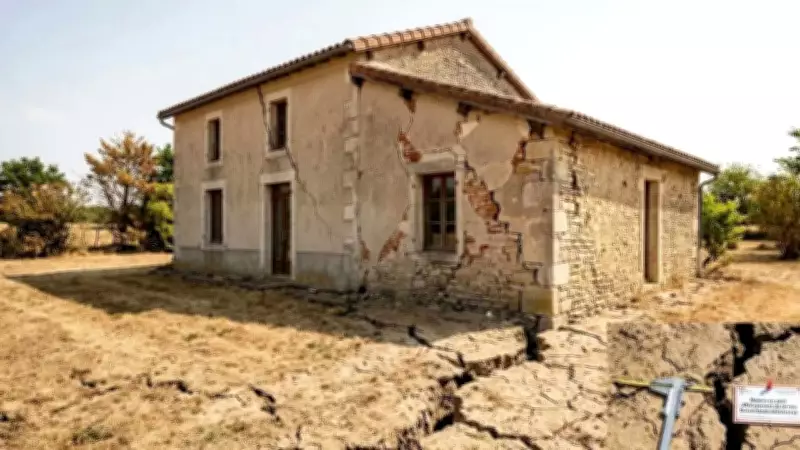
Climate Change Cracks French Foundations: Shrink-Swell Soil Crisis Threatens 10 Million Homes
The phenomenon known as 'Shrinking and Expanding'—where clay-rich soils contract during dry periods and swell when wet—has emerged as one of France's foremost geological hazards. Technically termed Retrait-Gonflement des Argiles, this process is intensifying due to climate change, posing severe risks to residential structures across the nation.
The Mechanical Reality of Shrink-Swell Soils
Clay-rich soils undergo continuous shrink-swell cycles in response to hydric stress and moisture fluctuations at the soil's upper boundary. According to research published in the NHESS Journal, climate change serves as the primary driver, increasing the frequency and intensity of what experts call 'geotechnical droughts.'
During heatwaves or prolonged hot spells, clay soils lose water and shrink dramatically. Conversely, when heavy rainfall follows drought, these soils rapidly absorb moisture and expand. This cyclic movement exerts tremendous force on building foundations, often exceeding structural limitations and leading to system failures.

10.4 Million Dwellings in the Danger Zone
The European Environment Agency estimates that approximately 10.4 million individual homes in France occupy medium to high-risk zones for shrink-swell soil activity. This represents about 50% of the country's detached housing stock. French Geological Survey (BRGM) data indicates even higher exposure, with over 11.2 million dwellings vulnerable.
Regional vulnerability mapping has been compiled at commune-level resolution, isolating and identifying areas based on current soil composition to better understand cumulative collapse risks and potential occurrence patterns.
The Economic Crisis: Over 21.5 Billion Euros in Cumulative Losses
The financial implications of soil subsidence have escalated significantly in recent years. According to the state-controlled Caisse Centrale de Réassurance (CCR), cumulative costs between 1989 and early 2026 are estimated at approximately 21.5 billion euros.
Projections indicate these costs could double by 2050 as much of France transitions from occasional drought conditions to structural hydric deficit, creating permanent foundation instability.
Beyond 2065: The Permanent State of Soil Deficit
Collaborative research by Météo-France and BRGM, utilizing IPCC Climate Change Scenarios (RCP 4.5 and 8.5), predicts substantially decreased soil moisture levels in coming decades. By 2065, the 'return period' for extreme soil-shrinking droughts will shorten dramatically.
Events that previously occurred once every 5 to 10 years may happen every few years, creating a permanent state of soil deficit that fundamentally alters France's geological stability.
This 'quiet crisis' represents a physical manifestation of climate change, with increasing numbers and intensity of extreme weather events transforming once-stable foundation structures into unstable liabilities affecting more than half of France's single-detached housing.






