Understanding the Fujiwhara Effect: When Cyclones Interact in the Bay of Bengal
For UPSC aspirants and weather enthusiasts alike, the Fujiwhara effect stands as a fascinating and critical example of how atmospheric dynamics can transform predictable weather patterns into complex, chaotic systems. This meteorological phenomenon, which involves the interaction of two cyclonic vortices, is particularly relevant in regions like the Bay of Bengal, where cyclone activity is frequent and impactful.
Origins and Discovery of the Fujiwhara Effect
The effect is named after the Japanese meteorologist Sakuhei Fujiwhara, who first described it in 1921. Fujiwhara's groundbreaking work provided a scientific explanation for what occurs when two cyclones, such as tropical storms or hurricanes, approach each other closely. His research laid the foundation for understanding how these powerful weather systems can influence one another's trajectories, leading to unpredictable movements that challenge forecasting models.
Mechanisms of Cyclonic Interaction
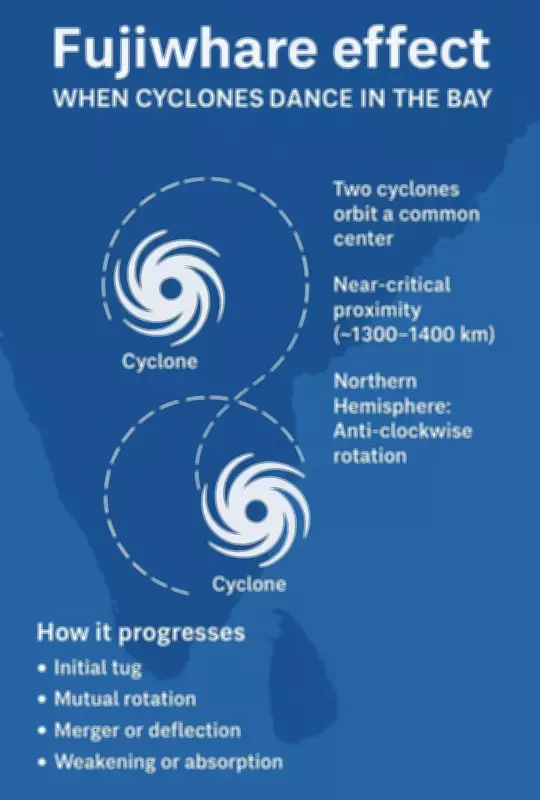
At its core, the Fujiwhara effect involves two cyclonic vortices—rotating masses of air with low pressure at their centers—coming into proximity. When this happens, they begin to orbit around a common center, much like a dance in the atmosphere. This interaction can result in several outcomes:

- Merging: The two cyclones may combine into a single, larger system, intensifying their strength and potential for destruction.
- Repulsion: In some cases, the cyclones push each other away, altering their paths in unexpected directions.
- Weakening: The interaction can sometimes lead to one or both cyclones dissipating, reducing their threat.
This dynamic is not just theoretical; it has been observed in real-world events, such as in the Bay of Bengal, where cyclones like Amphan and Fani have exhibited such behaviors, complicating predictions for coastal regions.
Importance for UPSC Aspirants and Meteorology
For UPSC aspirants, studying the Fujiwhara effect is essential for grasping advanced concepts in geography, environmental science, and disaster management. It highlights the complexities of atmospheric physics and underscores the importance of accurate weather forecasting in mitigating natural disasters. Understanding this effect can aid in answering questions related to climatology, cyclone formation, and global weather patterns in competitive exams.
Moreover, this phenomenon has broader implications for climate change and global warming, as shifting weather patterns may increase the frequency of such interactions. Researchers continue to monitor and analyze the Fujiwhara effect to improve predictive models and enhance preparedness for extreme weather events.
In summary, the Fujiwhara effect serves as a vivid reminder of nature's unpredictability and the intricate dance of atmospheric forces. By delving into its mechanisms and impacts, we gain valuable insights into the dynamic world of meteorology, benefiting both academic pursuits and practical applications in weather forecasting and disaster response.