

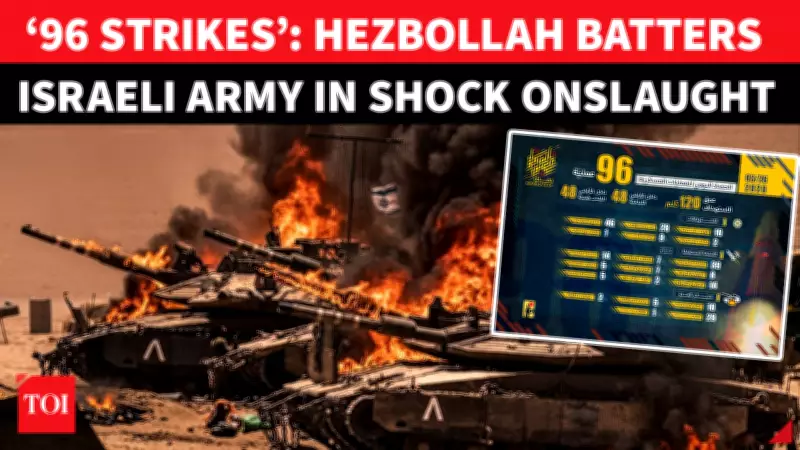
Hezbollah Claims Major Escalation with 96 Operations Against Israeli Forces
In a significant development in the ongoing Middle East conflict, Hezbollah has announced a series of coordinated military operations targeting Israeli forces. The Lebanese militant group claims to have conducted a total of 96 separate attacks, resulting in substantial damage to Israeli military infrastructure both inside Israel and in southern Lebanon.
Extensive Damage to Israeli Military Assets
According to Hezbollah's detailed report, their operations specifically targeted 10 different Israeli military bases across the region. Perhaps more significantly, the group claims to have successfully hit 29 Merkava tanks, which represent some of Israel's most advanced armored vehicles. These tanks are considered crucial components of Israel's ground defense strategy.
The attacks reportedly employed a wide array of weaponry, including tactical ballistic missiles, guided missiles, rockets, and sophisticated drone technology. This diverse arsenal allowed Hezbollah to conduct strikes across multiple fronts simultaneously, creating significant challenges for Israeli defense systems.

Geographic Reach and Strategic Targets
What makes these operations particularly noteworthy is their extensive geographic scope. Hezbollah claims their strikes extended up to 120 kilometers from their positions, reaching targets across both Lebanese and Palestinian territories. Most alarmingly for Israeli officials, the group says they successfully targeted military installations in Tel Aviv, including the strategically important HaKirya military complex.
The operations were not limited to border areas but penetrated deep into what Israel considers its sovereign territory. This represents a significant escalation in Hezbollah's capabilities and willingness to engage Israeli forces beyond traditional conflict zones.
Context and Motivation for the Escalation
Hezbollah officials have stated clearly that these coordinated attacks represent a direct response to what they characterize as Israeli aggression in the region. The scale and sophistication of these operations suggest careful planning and preparation, indicating that this escalation has been in development for some time.
The timing of these announcements coincides with increasing tensions throughout the Middle East, with multiple conflicts and proxy wars creating a volatile regional environment. Hezbollah's demonstrated ability to coordinate complex, multi-front operations represents a new phase in their conflict with Israel.
Military and Strategic Implications
The claimed destruction of 29 Merkava tanks, if verified, would represent one of the most significant losses of Israeli armored vehicles in recent conflicts. The Merkava series represents Israel's primary battle tank, with advanced defensive systems designed specifically for the type of threats Hezbollah has now demonstrated.
Equally concerning for Israeli military planners is the successful targeting of the HaKirya complex in Tel Aviv. This military headquarters serves as a nerve center for Israeli defense operations, and its vulnerability to attack raises serious questions about Israel's air defense capabilities against determined adversaries.
The extended range of Hezbollah's operations – reaching 120 kilometers – suggests either improved missile technology or strategic positioning that allows them to strike deeper into Israeli territory than previously demonstrated. This expanded operational radius fundamentally changes the security calculus for communities and military installations throughout northern and central Israel.
Regional Context and Broader Conflict
These developments occur against a backdrop of increasing regional instability. Multiple reports indicate heightened tensions involving Iran, the United States, and various regional actors. Hezbollah's actions appear coordinated with broader regional dynamics, potentially representing one front in a larger confrontation.

The sophistication of Hezbollah's operations – combining drones, guided missiles, and ballistic weapons – suggests significant technological advancement and possibly external support. The group's ability to coordinate 96 separate operations across a wide geographic area indicates substantial military planning and command capabilities.
As the conflict escalates, regional powers and international observers are closely monitoring developments. The targeting of Tel Aviv military installations represents a particularly dangerous escalation that could prompt significant Israeli responses and potentially draw other actors into the conflict.





