

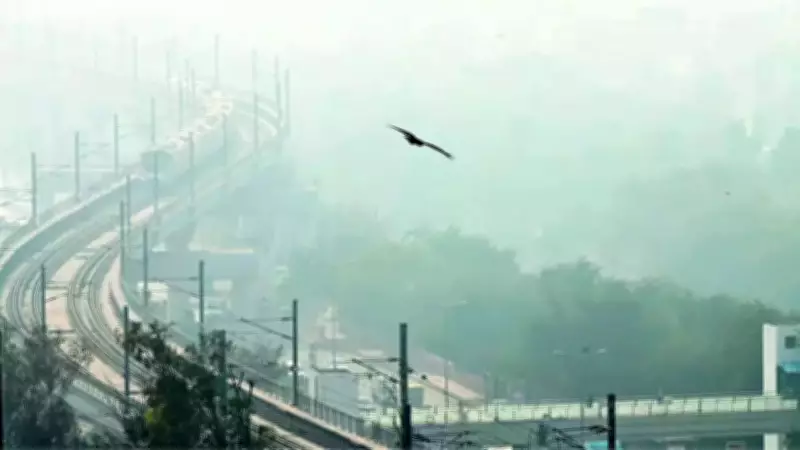
India's Winter Pollution Crisis Deepens in January, NCR Cities Dominate Rankings
India's severe winter air pollution crisis showed no signs of abatement throughout the month of January, with cities in the National Capital Region (NCR) overwhelmingly dominating the nation's pollution rankings. A comprehensive analysis reveals that nearly half of all monitored urban centers across the country have recorded dangerously high levels of fine particulate matter, consistently breaching the national safety standards established to protect public health.
Ghaziabad Emerges as Most Polluted, Delhi Follows Closely
According to a detailed analysis conducted by the Centre for Research on Energy and Clean Air (CREA), Ghaziabad has alarmingly emerged as India's most polluted city for the month of January. The city recorded a staggering monthly average PM2.5 concentration of 184 micrograms per cubic meter, a figure that is more than three times higher than the national permissible limit. Ghaziabad, which is consistently ranked among the most polluted pockets within the NCR, breached daily air quality standards on every single day of the month.
Delhi followed closely behind in second place, with an average PM2.5 level of 169 micrograms per cubic meter. The capital city recorded a distressing 27 days where air quality was classified as either 'very poor' or 'severe,' posing significant health risks to its millions of residents. Other NCR cities including Noida, Gurgaon, and Greater Noida also featured prominently in the top five most polluted locations, underscoring the regional nature of the crisis.

Widespread Non-Compliance Across Urban India
The scale of the problem is truly national in scope. Out of 248 cities with reliable and consistent air quality monitoring data, a shocking 123 urban centers breached India's National Ambient Air Quality Standards (NAAQS) for fine particulate matter, also known as PM2.5. Even more concerning is the fact that not a single Indian city managed to meet the World Health Organization's stringent daily safe guideline for air quality, highlighting the immense public health challenge posed by chronically polluted air.
The pollution crisis cuts across both cities covered under the National Clean Air Programme (NCAP) and those outside its ambit. Among the 97 NCAP cities with sufficient data, 46 exceeded India's daily PM2.5 standards. A similar and equally troubling trend was observed in non-NCAP cities, where 77 locations crossed the national limit, and all 151 cities monitored exceeded the stricter global benchmark set by the WHO.
State-Level Analysis and Cleanest Cities
At the state level, Rajasthan topped the list for widespread non-compliance, with 23 of its 34 monitored cities exceeding the PM2.5 standard. Other states reporting significant air quality issues included Haryana, Bihar, Odisha, and Uttar Pradesh. Notably, Uttar Pradesh and Haryana together accounted for six of the ten most polluted cities in the country for January.
Other cities appearing in the top ten most polluted list were Dharuhera in sixth place, followed by Singrauli, Bhiwadi, Narnaul, and Gangtok. Nationally, air quality remained heavily skewed towards unhealthy scores. Only 21 cities recorded 'good' air quality, while 103 were classified as 'satisfactory' and 92 as 'moderate.' Another 32 cities suffered under 'poor' or 'very poor' air quality conditions throughout the month.
On a positive note, Damoh in Madhya Pradesh emerged as India's cleanest city in January, with an exceptionally low average PM2.5 level of just 17 micrograms per cubic meter. Interestingly, five of the ten cleanest cities are located in the southern state of Karnataka. Among India's megacities, Delhi and Kolkata exceeded national limits, while Chennai, Mumbai, and Bengaluru managed to stay within them, indicating a north-south divide in air quality.

Urgent Calls for Policy Revision and Stronger Action
In light of these alarming findings, CREA has issued a strong call for urgent and decisive policy action. The organization emphasized that the upcoming revision of the National Clean Air Programme presents a critical opportunity to significantly strengthen India's air quality management framework. "To mitigate this recurring and year-long pollution, the revision of the National Clean Air Programme (NCAP) presents a key opportunity to strengthen India's air quality management," stated Manoj Kumar, India analyst at CREA.
The recommended revisions must focus on several key areas: prioritizing the reduction of PM2.5 and its precursor gases like sulfur dioxide (SO2) and nitrogen dioxide (NO2) over the larger PM10 particles, revising the official list of non-attainment cities, setting stricter emission standards for industrial sectors and thermal power plants, and most importantly, adopting a comprehensive airshed-based approach to address air pollution at a regional scale rather than confining efforts to arbitrary city boundaries. This holistic strategy is deemed essential for tackling the transboundary nature of air pollution that plagues regions like the NCR.





