

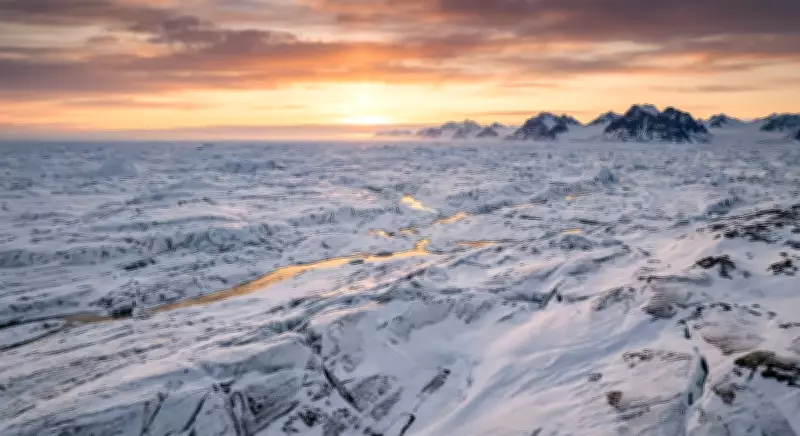
Most people are familiar with one version of the Greenland story: ice melting, seas rising, glaciers receding in time-lapse videos that make climate change seem real and immediate. That version is real, but it is also incomplete, because underneath all that melting lies something scientists are only beginning to fully understand. It is one of the most detailed climate journals the planet has ever kept.
Greenland's Ice: More Than Frozen Water
Greenland's ice sheet is not just frozen water; it is a stacked physical record of everything the Earth's climate has done over thousands of years. As temperatures rise and extreme weather becomes the new normal for Americans from Miami to Minneapolis, this frozen archive is becoming one of the most important tools scientists have. It is not only the largest ice sheet outside Antarctica but also the most significant due to what it contains.
What Makes Greenland's Ice So Important?
A review titled "Ice Sheets Big and Small" suggests that ice-sheet history is a geological footnote, yet it provides one of the clearest lenses for interpreting future climate change. Ice preserves signals of past thermal states, much like tree rings for the entire planet, but older and far more detailed. Each layer of ice in Greenland is a snapshot of the atmosphere at a given time. Temperature, dust, gas bubbles, and even the chemistry of ancient rainfall are all preserved, stacked up like the world's most patient filing system.

Frozen Evidence Could Rewrite Climate History
A study published in Nature Geoscience reveals that entrained debris and internal structures within northern Greenland contain evidence that the ice sheet regenerated following the last interglacial period, around 125,000 years ago, when global temperatures were similar to projections for the coming decades. This indicates not only that Greenland survived a warmer-than-now period but also that it bounced back afterward, leaving physical signs of that recovery locked in the ice. This shifts the climate conversation. Scientists can observe what happened the last time temperatures were this high and how the ice sheet recovered, rather than just focusing on how fast it is melting now.
Implications for Sea Level Rise and Policy
These are not just theoretical questions. Whether the Greenland ice sheet has been resilient in the past or is approaching a tipping point has real implications for sea level projections, infrastructure planning, and the urgency of action for people living in coastal cities or debating climate policy.
A Warming Planet Makes This Archive More Relevant
Recent melt events in Greenland have broken records, and scientists are scrambling to put these extremes into historical perspective. That is why the internal record is so important now. When observing something changing at an unprecedented rate, the longest possible reference point is needed to understand what "unprecedented" truly means. Greenland is more than just a climate morality play. It is melting, yes, but it is also preserving a memory of every time the climate swung hard before, and what came after. That memory is written into layers of debris, the structure of ice crystals, and the physical geometry of a sheet that has thickened, flowed, fractured, and re-formed over thousands of years.
The Archive Is Not Passive
One of the more counterintuitive aspects of Greenland is that it is valuable as an archive precisely because it is constantly changing. As the ice sheet moves and shifts, it incorporates evidence of those changes into itself. It is not so much a museum as a living record, adding new pages as we read the old ones. This is a vital reframing of the story for US millennials and Gen Z, who have grown up with climate change as a constant backdrop. Greenland is not only a symbol of what we are losing; it is also one of the best tools we have to understand the overall arc of what is happening, where we have been, what the thresholds are, and what the planet looked like the last time it was running this hot.






