

New Gujarat Highway Plan Sparks Urgent Debate Over Asiatic Lion Protection
As plans solidify for a 90-kilometer National Highway 351-K connecting Bagasara in Amreli district to Una in Gir Somnath district via Dhari and Khambha, intense scrutiny has emerged regarding the delicate balance between road infrastructure development and the safety of endangered Asiatic lions. This two-lane highway project will traverse the Greater Gir landscape, a vital movement corridor for lions in Gujarat, prompting the forest department to initiate a comprehensive scientific assessment of wildlife activity in the region.
Critical Corridor at Risk: Highway Cuts Through Lion Movement Zone
The proposed highway alignment slices directly through an area that functions as an essential movement zone for lions dispersing between core protected territories and surrounding landscapes. With approximately 300 lions inhabiting Greater Gir and adjacent districts, the stakes are exceptionally high. In January alone, two lionesses tragically perished in separate vehicle collisions on the Bhavnagar–Somnath highway in Jafrabad taluka, highlighting the urgent need for effective mitigation strategies.
However, a recent Comptroller and Auditor General (CAG) report reveals a troubling pattern: while such scientific studies and recommendations are routinely prepared for road projects, their actual implementation has historically been weak or entirely absent. This gap between planning and execution raises significant concerns about the future safety of lion populations along this new corridor.

Scientific Study Maps Wildlife Movement Patterns
To address these risks proactively, the Gir East forest division conducted an exhaustive scientific investigation of lion movement across the proposed highway route. The research team employed GPS tracking data, daily field monitoring, and long-term ecological knowledge of the region to meticulously map wildlife movement patterns and pinpoint critical crossing points along the corridor.
Based on these detailed findings, the highway stretch has been categorized into four distinct risk zones:
- Red Zones: Designated for critical wildlife corridors with high movement activity.
- Orange Zones: Areas with moderate wildlife movement.
- Yellow Zones: Sections with minimal wildlife activity.
- Green Zones: Segments where risks to wildlife are relatively low.
High-Risk Segments and Proposed Mitigation Measures
One of the most sensitive stretches identified in the study is the Borala–Kantala segment, spanning approximately 70 kilometers. This area serves as a crucial corridor supporting gene flow between the core Gir lion population and coastal habitats, making its protection paramount for genetic diversity. Another significant section, the Dhokadva–Una stretch, though containing fewer forest patches, records frequent movement of leopards that have adapted to agricultural fields and village landscapes.
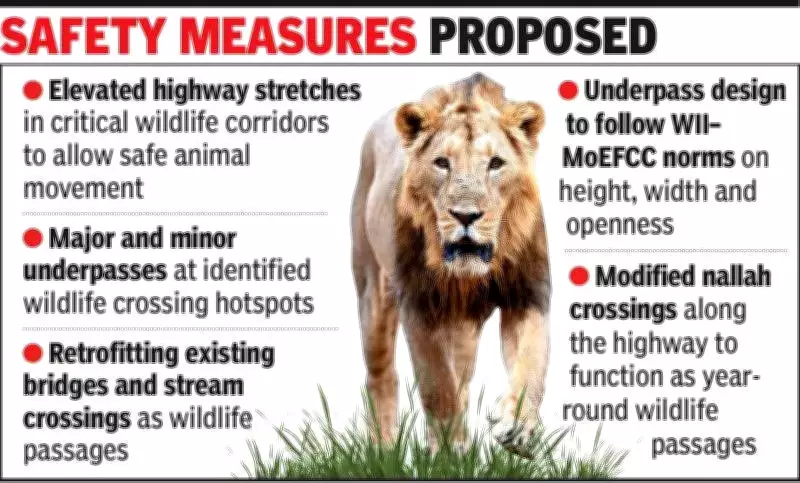
To mitigate these risks, the forest department has proposed several infrastructure interventions:
- Constructing elevated highway sections in high-risk red zones.
- Building dedicated wildlife underpasses, particularly along stretches such as Hamapur–Tri Junction and Kantala–Pachpachiya.
- Modifying existing bridges and seasonal stream crossings to function as year-round wildlife passages, including during monsoon seasons.
"These interventions are absolutely necessary to maintain safe and uninterrupted wildlife movement and to preserve genetic connectivity among lion populations," emphasized Vikas Yadav, deputy conservator of forests, Gir (East).
Call for Collaborative Implementation and Verification
The proposal further recommends that the National Highways Authority of India (NHAI) and the forest department conduct joint field surveys to verify the identified wildlife hotspots. This collaborative approach aims to ensure that mitigation measures are seamlessly integrated into the final highway design from the outset, rather than being added as an afterthought.

As Gujarat moves forward with this infrastructure project, the world watches closely to see if lessons from past failures will be heeded, ensuring that development does not come at the cost of endangering one of India's most iconic and vulnerable species.





