Gurgaon's Air Quality Takes a Dangerous Dive
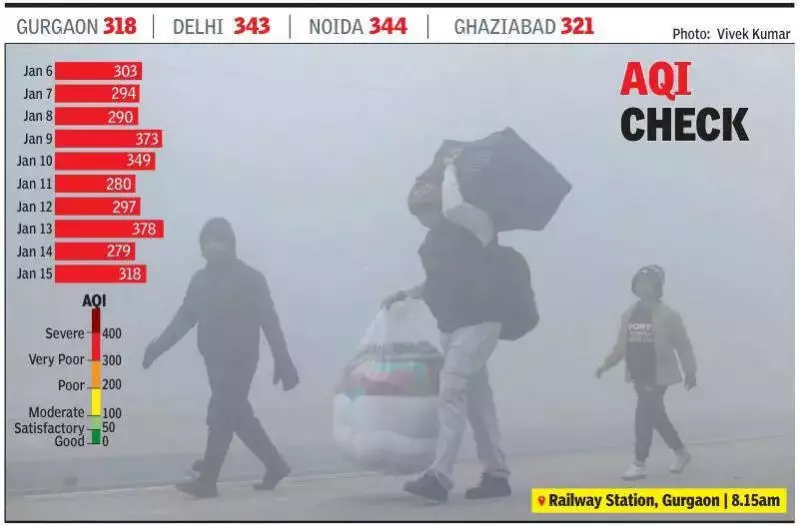
Gurgaon residents woke up to dangerously polluted air on Thursday. The city's air quality index (AQI) jumped sharply to 318, a significant rise from 279 recorded the previous day. This placed Gurgaon firmly in the 'very poor' category, triggering health concerns across the city.
Widespread Pollution Across Monitoring Stations
All four air quality monitoring stations in Gurgaon reported 'very poor' readings. This indicates that pollution was not localized but spread uniformly throughout the urban area. Gwal Pahari recorded the highest AQI at 334, followed closely by Teri Gram at 320. Vikas Sadan registered 314, while Sector-51 showed a reading of 302.
Immediate Health Risks for Vulnerable Groups
The 'very poor' air quality poses serious health threats, particularly for children, elderly citizens, and individuals with existing respiratory conditions. Prolonged exposure to such polluted air can cause breathing discomfort and may lead to respiratory illnesses. Many residents reported experiencing throat irritation and eye discomfort throughout the day.

Multiple Factors Contribute to Pollution Build-up
Several factors combined to create this hazardous situation. Winter conditions restricted the natural dispersion of pollutants, trapping them close to the ground. Local sources including road dust, heavy vehicular traffic, and ongoing construction activities added significantly to the pollution load. Fine particulate matter, known as PM2.5, emerged as the primary pollutant, reflecting typical winter pollution patterns in the region.
Official Monitoring and Future Forecast
Government officials confirmed they are closely monitoring the air quality situation. They stated that advisories would be issued immediately if conditions worsen further. The Delhi government's forecasting agency, the Decision Support System (DSS), has flagged unfavourable dispersion conditions expected to persist over the coming days.
The ventilation index is projected to remain below 6,000 m²/s on multiple days. Low wind speeds will limit the atmosphere's ability to clear pollutants effectively. Current forecasts indicate air quality will stay in the 'very poor' category from January 15 to January 17. There is a possibility of conditions slipping into the 'severe' category by January 18.
Understanding AQI Categories and Health Impacts
According to Central Pollution Control Board guidelines, different AQI levels carry specific health implications. Air quality classified as 'moderate' (101-200) can cause breathing discomfort for people with asthma, heart disease, or lung conditions. 'Poor' air quality (201-300) may cause discomfort for most people during prolonged exposure.
The AQI scale ranges from 0 to 500. Levels between 0 and 50 are considered 'good', while 51 to 100 is 'satisfactory'. The 'moderate' category covers 101 to 200, 'poor' includes 201 to 300, 'very poor' spans 301 to 400, and anything above 401 falls into the 'severe' category. Gurgaon's current reading of 318 places it squarely in the hazardous 'very poor' zone.
Visibility remained slightly hazy through the morning hours, adding to residents' concerns. The combination of local pollution sources and unfavourable weather conditions has created a challenging environment for Gurgaon's population. Authorities continue to monitor the situation while citizens take precautions against the deteriorating air quality.