

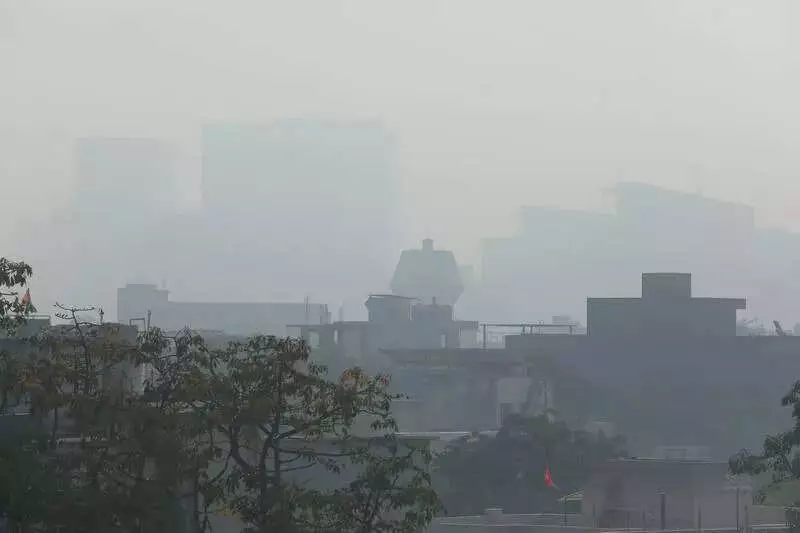
Residents of Gurgaon woke up to a thicker haze and significantly deteriorated air on Saturday, as the city's Air Quality Index (AQI) slipped back into the 'very poor' category. The index rose to 314 from 298 recorded on Friday, marking a severe health risk for vulnerable populations including children, the elderly, and individuals with pre-existing respiratory conditions.
Monitoring Stations Paint a Grim Picture
Data from the city's four monitoring stations revealed alarming levels of pollution. Sector 51 recorded the highest AQI at 350, firmly in the 'very poor' range. It was closely followed by Teri Gram at 339 and Gwal Pahari at 306. Vikas Sadan was on the brink, remaining in the 'poor' category with an AQI of 286, which is perilously close to the 'very poor' threshold.
Hazardous Particulate Matter Concentrations
The primary driver of this air quality crisis was a dangerous spike in toxic particulate matter. Levels of PM2.5—fine particles that can penetrate deep into the lungs and bloodstream—breached hazardous limits across Gurgaon.

The situation was most critical in Sector 51, where PM2.5 concentration hit 500 micrograms per cubic metre (µg/m³). This staggering figure is more than 33 times the World Health Organisation's (WHO) annual safe limit of 15 µg/m³. Other areas also recorded dangerously high levels: Teri Gram at 394 µg/m³, Gwal Pahari at 388 µg/m³, and Vikas Sadan at 304 µg/m³.
The larger PM10 particles were also a major concern. In Gwal Pahari, PM10 levels touched 400 µg/m³, which is nearly eight times the WHO's safe guideline of 45 µg/m³. Vikas Sadan logged 150 µg/m³ for PM10. The annual safe standards set by India's Central Pollution Control Board (CPCB)—60 µg/m³ for PM2.5 and 100 µg/m³ for PM10—were exceeded at almost all monitoring locations.
Weather Conditions Trap Pollutants
The System of Air Quality and Weather Forecasting and Research (SAFAR) attributed the worsening conditions to meteorological factors that are hindering the dispersal of pollutants. The agency forecast that air quality could remain in the 'very poor' category for the next six days.
Weather conditions included a partly cloudy sky, mist or haze in the mornings, and daytime surface wind speeds of 15 to 20 kmph. Winds were expected to blow from the west in the morning and from the northwest during the day. A critical factor is the low ventilation index, which SAFAR predicted would be around 6,000 m²/s on Saturday.
"A ventilation index below 6,000 m²/s combined with wind speeds under 10 kmph creates unfavourable conditions for pollutant dispersion," SAFAR stated. The maximum mixing depth was likely to be around 900 metres, leading to stagnant air and higher concentrations of pollutants near the surface where people live and breathe.
Meanwhile, temperatures saw a slight increase. The minimum temperature rose to 8.6 degrees Celsius on Saturday from 6.9 degrees Celsius on Friday. The maximum temperature also increased slightly to 23.8 degrees Celsius from 21.9 degrees Celsius the previous day.
According to the India Meteorological Department (IMD), minimum temperatures are expected to rise by 2 to 3 degrees Celsius over the next 48 hours across the state, followed by a drop of 3 to 5 degrees Celsius. "Wind velocity has increased and cloudiness has led to a rise in temperatures. A similar trend will continue for the next two days before the mercury starts falling. Moderate to shallow fog is likely at isolated places in the state," an IMD official said.
The persistent 'very poor' air quality poses serious health threats, especially to sensitive groups. Doctors advise limiting outdoor activities, using N95 or higher-grade masks when outside, and employing air purifiers indoors. The data underscores the urgent need for sustained measures to combat the sources of pollution in the National Capital Region.






