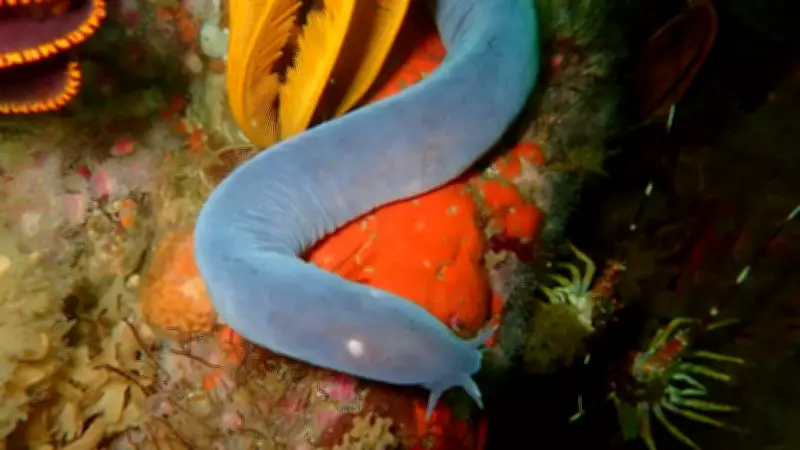
The Hagfish: A 300-Million-Year-Old Survivor of the Deep Sea
In the frigid, lightless depths of the ocean, one of evolution's most peculiar champions thrives: the hagfish. Often called the 'slime monster,' this eel-like creature has endured over 300 million years, outlasting even the formidable dinosaurs. Far from being a weak relic, this ancient animal boasts one of the most bizarre and effective defense mechanisms in the animal kingdom. Instead of relying on speed or strength, the hagfish employs a chemical strategy to escape predators, releasing copious amounts of slime that can even deter sharks. This unique adaptation makes the hagfish a captivating marine marvel and a powerful example of survival through unconventional means.
What Is the Hagfish and Why Is It Dubbed a Slime Monster?
The hagfish is a jawless, eel-like fish that inhabits ocean floors worldwide. As one of the most primitive vertebrates still in existence, it has remained largely unchanged for millennia, with fossils dating back hundreds of millions of years showing minimal structural evolution. Unlike typical fish, it lacks jaws, bones, and a vertebral column, possessing only a soft body and a skull. Its name stems from an extraordinary ability: specialized glands in its body produce a protein-based substance that, when threatened, expands explosively upon contact with seawater. This slime can grow thousands of times its original size in under a second, creating a thick, fibrous barrier that instantly envelops the surrounding water.
How Does Hagfish Slime Suffocate a Shark?
This slime serves as more than just a shield; it is a critical survival tool. When attacked by predators like sharks, the hagfish releases its slime into the water, where it can clog the gills of the assailant, leading to potential suffocation. Research published in PubMed confirms that hagfish slime expands rapidly and disrupts gill function, effectively hindering breathing. Even against larger foes, this defense can force a retreat within seconds, allowing the hagfish to escape unharmed. This mechanism highlights how a seemingly simple creature can overcome formidable threats through biochemical ingenuity.

Survival Without Speed or Strength
Hagfish defy conventional survival strategies by eschewing speed and combat prowess. Instead, they thrive on efficiency and unique adaptations. Primarily found on nutrient-scarce ocean floors, they feed on dead and decaying matter, burrowing into carcasses from the inside. This scavenging lifestyle minimizes competition and maximizes resource use, showcasing their role as nature's recyclers.
A Creature Barely Changed by Evolution
One of the hagfish's most intriguing aspects is its evolutionary stasis. Fossils reveal that these animals have altered little over millions of years, with modern specimens closely resembling ancient ones. This consistency suggests that their design and survival techniques are exceptionally effective, proving that simplicity can be a key to longevity in nature's harsh environments.
The Science Behind the Slime
The hagfish's slime is composed of proteins and fibers that intertwine with water to form a gel-like material. These fibers are remarkably strong, elastic, and durable, contributing to the slime's defensive potency. Scientists are studying this substance for potential applications, such as creating sustainable fibers for new materials or developing protective gear due to its resilience and flexibility.
Importance to Ocean Ecosystems
Despite its unappealing habits, the hagfish plays a vital role in marine ecosystems. By consuming dead animals, it recycles nutrients back into the environment, preventing the accumulation of organic matter on the seafloor. This process helps maintain ecological balance, and the absence of hagfish could disrupt ocean health significantly.
What Hagfish Reveal About Evolution
The hagfish demonstrates that survival in nature does not always require strength or speed but can hinge on specialized adaptations. Its ability to persist alongside more complex creatures underscores evolution's support for simplicity and weirdness. As one of the oldest inhabitants of the sea, the hagfish stands as a testament to the power of unique traits in ensuring enduring existence.