Haryana's Air Quality Monitoring Network Expansion Faces Critical Shortfall
Gurgaon: The air quality monitoring network in Haryana is poised for expansion, but the planned addition of only seven new continuous ambient air quality monitoring stations (CAAQMS) has sparked concerns among regulators. The Commission for Air Quality Management (CAQM) highlighted a significant gap in monitoring coverage across the state, emphasizing the need for a more comprehensive approach to pollution surveillance.
Current Monitoring Infrastructure and Deficiencies
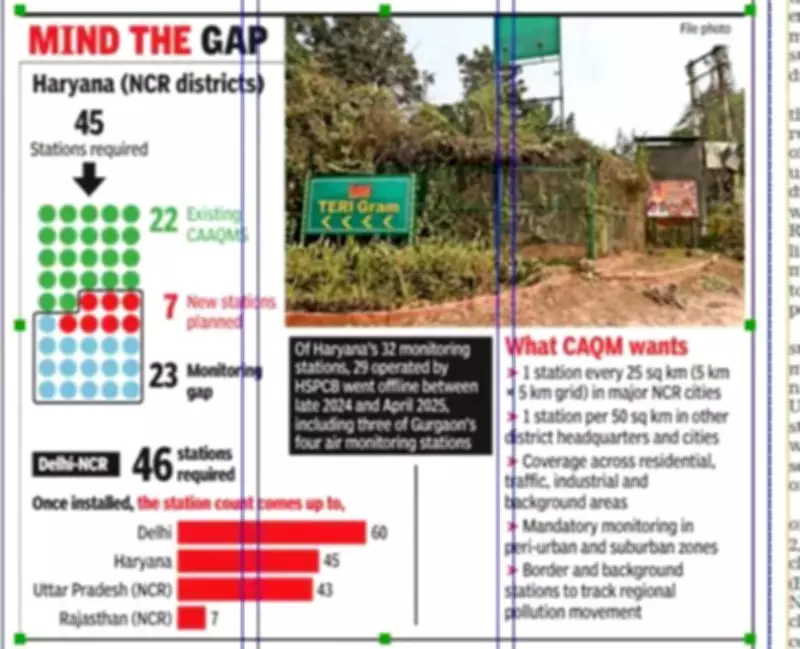
Currently, Haryana operates 22 CAAQMS in its National Capital Region (NCR) districts. However, a recent assessment by CAQM reveals that the state requires 45 monitoring stations to achieve scientifically robust and uniform air quality surveillance. This indicates a substantial shortfall of 23 stations, raising questions about the effectiveness of existing infrastructure.
In a troubling development, many NCR stations experienced prolonged outages last year. Between late 2024 and April 2025, 29 of the 32 monitoring stations operated by the Haryana State Pollution Control Board (HSPCB) went offline. This included three out of four monitors in Gurgaon and all stations in Faridabad, Hisar, Karnal, Rohtak, and Yamunanagar. During this period, only two stations managed by the India Meteorological Department (IMD) at Gwalpahari in Gurgaon and Panchkula continued to record data. Additionally, one AQI monitoring station is currently operated by a private agency at Pachgaon. Several stations, including those in Gurgaon, were restored on October 1, but the reliability of the network remains a pressing issue.

Scientific Criteria for Network Expansion
CAQM conducted a detailed review of the scientific criteria for expanding the air quality monitoring network in Delhi-NCR. The commission stressed that monitoring density must reflect population distribution and land-use characteristics, including residential areas, traffic corridors, industrial zones, and background locations. Special emphasis was placed on urban contiguity and the rapid expansion of peri-urban and suburban regions, which are particularly relevant for Haryana's fast-growing NCR towns like Gurgaon, Faridabad, and Sonipat.
Under revised norms, CAQM adopted a grid-based spatial coverage model. For major urban and contiguous NCR cities, one monitoring station is required for every 25 square kilometers (5 km × 5 km grid). Other district headquarters and cities would need one station per 50 square kilometers. The commission also underlined the necessity for background and border stations to better understand regional pollutant transport and baseline air quality levels influencing NCR cities.
Future Requirements and Regional Impact
Monitoring coverage in peri-urban and suburban areas was identified as critical to assess pollution inflow and outflow and to study the impact of urban sprawl on regional air quality. Based on these criteria, CAQM assessed that 46 additional stations are required across Delhi-NCR, including 16 in Haryana's NCR region. Once installed, the total number of CAAQMS in the region would rise to 157, with 45 stations in Haryana, 60 in Delhi, 43 in Uttar Pradesh (NCR), and 9 in Rajasthan (NCR).
The commission reiterated that a dense and evenly distributed monitoring network is essential for accurate assessment, regulatory enforcement, and effective air pollution mitigation across the NCR. This expansion is crucial for addressing the growing environmental challenges in rapidly developing areas.