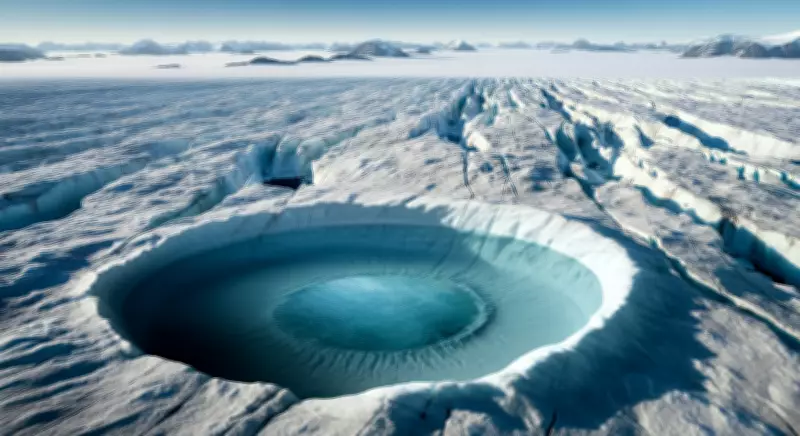
Picture yourself gazing at an endless expanse of perfectly flat and uniform snow stretching as far as your eyes can see. The Hiawatha Glacier, located in northwestern Greenland, is a giant glacier that seems to be utterly devoid of any features. For many decades, the area had been studied extensively from the air with no evidence of anything unusual below the surface, which consisted of just solid bedrock. Yet, when a group of researchers used highly advanced radar equipment to look beneath the surface, they discovered something incredible. Concealed under five hundred feet of ice is an enormous crater caused by an asteroid impact.
A Crater Among the World's Largest
The crater was listed among the 25 largest impact craters in the world by NASA, which makes it the first instance of such a discovery ever made underneath a continental ice sheet. The discovery is revolutionary for the way we view the frozen regions of the planet. The example illustrates the fact that even the most enormous geological surprises can be hidden right under our noses, preserving their integrity perfectly well.
Interpreting the Scene of a Crime Through the Ice Layer
How could the researchers make the discovery knowing that the impact was hidden underneath kilometres of solid ice? No, they did not stumble upon any holes in the ice cover; rather, they turned to the images obtained via air-borne radar surveys. Once these signals passed through the glacier and returned, they made it possible to draw a picture of the ground underneath showing a distinctive depression with a rim and a centre elevated above the rest of it.

Yet, the appearance of a perfect circle on the radar screen does not mean much. The proof for the asteroid hit was given by the meltwater emerging from below the ice sheet. In the groundbreaking paper published in Science Advances titled "A large impact crater beneath Hiawatha Glacier in northwest Greenland," scientists analysed the sand and sediments that emerged from the glacial meltwater. And they discovered a geological murder scene. The scientists found evidence of the presence of "shocked quartz." This term refers to small grains of quartz sand that are altered in shape due to extreme pressures that arise during an impact. The analysis of the chemical composition of the sediments showed that the asteroid was an enormous space iron rock. This confirms a massive impact occurred approximately 58 million years ago. The discovery changes how we view polar ice sheets, suggesting they hide many ancient geological secrets.
A Geological Riddle Frozen in Time
Now, when the presence of the impact crater was confirmed, another mystery was posed to science. The ice sheets on Earth are incredibly heavy, moving continuously, acting as giant pieces of sandpaper that erode landscapes beneath them for millennia. Thus, such a sharp impact crater as the Hiawatha crater must have been erased long ago.
Initially, many experts assumed the impact must have been incredibly recent, perhaps happening right at the end of the last ice age when humans were already walking the earth. But subsequent research changed the timeline entirely. A follow-up study also published in Science Advances titled "A Late Paleocene age for Greenland’s Hiawatha impact structure" used radioactive dating on the rocks and concluded that the impact actually happened roughly 58 million years ago during the Late Palaeocene epoch. This means the crater is an ancient survivor that has somehow outlasted millions of years of shifting ice and climate cycles.
Implications for Understanding Polar Regions
The discovery provides a whole new perspective on understanding Earth’s polar regions. The icy landscapes of Greenland and Antarctica are no longer considered to be blank sheets; instead, they are understood to be gigantic lids covering a mysterious landscape below them. There may be all kinds of geological mysteries lying beneath the icy blanket, including long-extinct rivers, dried-up lakes, and massive scars left behind by celestial bodies that collided with Earth’s surface millions of years ago. It shows that Hiawatha proves that there are plenty of secrets hidden in plain sight on Earth’s surface yet to be unveiled by new technologies.