

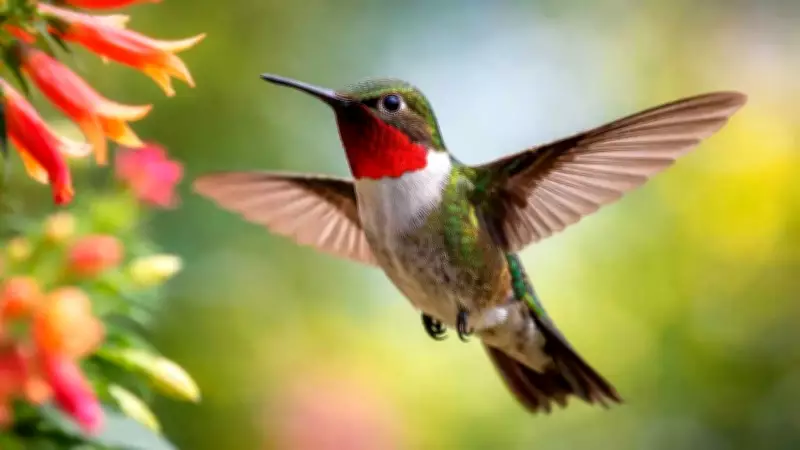
The fascinating story of hummingbirds traces back millions of years to a pivotal geological event that shaped their evolutionary path. When tectonic forces reshaped South America and the majestic Andes Mountains began their ascent, this dramatic environmental transformation created the perfect conditions for hummingbird diversification. This rapid evolutionary process ultimately produced the extraordinary variety of hummingbird species we observe across the Americas today.
The Extreme Biology of Hummingbirds
Despite their diminutive size, hummingbirds possess biological systems operating at remarkable extremes rarely seen in the animal kingdom. Their evolutionary refinement is most visible in their specialized physiology. During intense flight activity, a hummingbird's heart can accelerate to approximately 1,200 beats per minute, generating the immense power required for their unique aerial capabilities.
Flight Mechanics and Energy Requirements
This cardiovascular power fuels wings that move through complete cycles, incorporating both upstrokes and downstrokes in a figure-eight pattern. This sophisticated wing motion enables hummingbirds to perform their signature hovering maneuver and even fly backward—a capability exceptionally rare among avian species. Their aerial agility and speed defy their tiny proportions, making them masters of three-dimensional flight.

The hummingbird's metabolic system operates at similarly extreme levels. Their bodies can process and burn sugar within mere minutes of consumption, necessitating nearly constant feeding throughout daylight hours. To maintain their energy balance, hummingbirds typically require feeding every 10 to 15 minutes during active periods.
Dietary Needs and Energy Conservation
While hummingbirds primarily consume nectar—a simple mixture of sugar and water that provides rapid energy—this sweet liquid lacks essential nutrients. To obtain necessary proteins, vitamins, and minerals, hummingbirds supplement their diet with small insects and spiders. The nectar serves as their primary fuel source, while insects provide crucial nutritional building blocks.
At night, hummingbirds employ an ingenious energy-saving strategy called torpor. During this state, their metabolism slows dramatically, reducing energy requirements by up to 95% compared to daytime levels. This physiological adaptation allows them to conserve vital resources during periods when feeding isn't possible, ensuring survival through the night.
Behavioral Intelligence and Navigation
Beyond their physical extremes, hummingbirds demonstrate remarkable cognitive abilities and navigational skills. Many species undertake impressive seasonal migrations, traveling thousands of kilometers between breeding and wintering grounds with precise timing and route fidelity.
Spatial Memory and Foraging Efficiency
Hummingbirds possess exceptional spatial memory capabilities that optimize their foraging efficiency. Individual birds can remember the locations of hundreds of flowers within their territory, creating detailed mental maps of nectar resources. Even more impressively, they track the replenishment schedules of these flowers, remembering exactly when each blossom will contain fresh nectar.
This sophisticated memory system enables hummingbirds to minimize energy expenditure while maximizing nectar intake—a crucial advantage in competitive ecosystems where food resources are limited. By systematically visiting flowers at optimal times, they avoid wasted visits to empty blossoms and reduce unnecessary flight.
Modern Adaptations to Changing Environments
In recent decades, hummingbirds have demonstrated remarkable behavioral flexibility in response to human-altered landscapes. Researchers have documented significant range expansions and behavioral shifts as these birds adapt to contemporary environmental changes.

Urban Expansion and Supplemental Feeding
Species like Anna's Hummingbird have extended their northern ranges in North America, partly attributed to the widespread availability of sugar-water feeders in urban and suburban areas. These artificial food sources provide reliable nutrition during winter months when natural nectar is scarce. A comprehensive 2017 study published in Proceedings of the Royal Society B established a strong correlation between winter range expansion in Anna's Hummingbird and the prevalence of supplemental feeding by humans.
Climate Change and Migration Patterns
Scientific monitoring reveals that hummingbirds are adjusting their migration timing in response to environmental shifts. Long-term banding data indicates gradual changes in the seasonal arrival patterns of species like the Ruby-throated Hummingbird. Researchers suggest these timing adjustments may be linked to warmer temperatures and altered flowering cycles of their nectar sources.
These behavioral modifications demonstrate that hummingbirds are actively recalibrating their strategies across multiple dimensions—including range distribution, migration timing, and feeding behaviors—within observable timescales. Rather than merely reacting to environmental change, they're proactively adapting to new ecological realities.
Evolutionary Resilience Across Millennia
From their origins during the Andean uplift to their current success in urban gardens, hummingbirds have exhibited extraordinary evolutionary resilience. Their survival has never depended on size alone, but rather on their unique combination of flight mastery, cognitive abilities, and behavioral flexibility.
These remarkable birds serve as living examples of how species can respond dynamically to rapidly changing worlds. They represent not merely artifacts of evolutionary history, but active participants in ongoing ecological processes. As hummingbirds continue to adapt to human-dominated landscapes, they offer valuable insights into wildlife resilience and the complex interplay between natural evolution and anthropogenic environmental change.





