

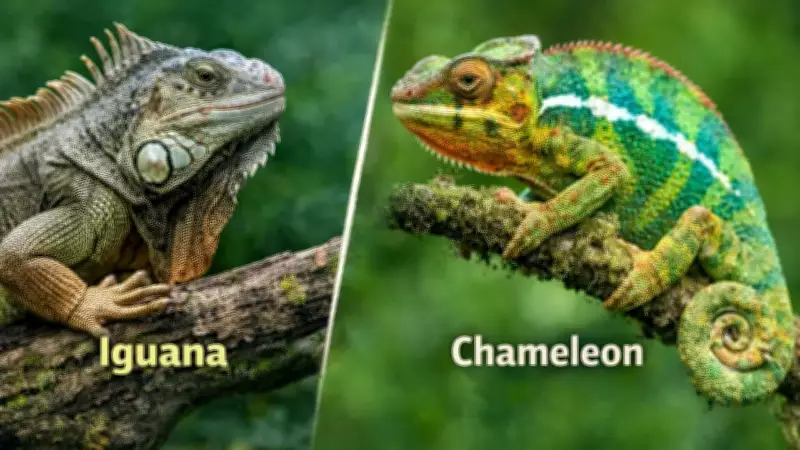
Iguana vs. Chameleon: Understanding Two Distinct Reptilian Worlds
While both iguanas and chameleons are often grouped under the broad category of exotic lizards, these remarkable reptiles exhibit profound differences in appearance, behavior, and biological adaptations. Despite sharing the reptile classification, they have evolved under vastly different environmental pressures, developing unique survival strategies that set them apart in the animal kingdom. Recognizing the distinctions between an iguana and a chameleon goes beyond mere identification; it offers valuable insights into how species adapt to their surroundings and the critical roles they play within their ecosystems.
Size and Physical Characteristics: A Study in Contrasts
One of the most striking differences between these two lizards is their size. Iguanas are significantly larger, often reaching lengths of 5 to 6 feet when including their tails, whereas most chameleon species rarely exceed 2 feet in length. Physically, iguanas feature elongated bodies adorned with spiny crests along their backs and a distinctive dewlap beneath their necks. In contrast, chameleons possess flattened bodies that facilitate agile movement along tree branches, showcasing their arboreal lifestyle.
Geographical Distribution and Habitat Preferences
Iguanas and chameleons inhabit entirely different regions of the globe. Iguanas are predominantly found in the tropical forests of South America, where they thrive in lush, verdant environments. Chameleons, on the other hand, are primarily native to Africa and Madagascar, with a few species also residing in parts of Asia. This geographical separation means these two species rarely, if ever, encounter each other in the wild, further emphasizing their distinct evolutionary paths.

Color Change and Defense Mechanisms
Chameleons are renowned for their extraordinary ability to change color, a trait that serves multiple functions including thermoregulation, communication, and predator evasion. While iguanas can blend into their surroundings to some extent, they do not possess the same dynamic color-changing capabilities. Instead, iguanas rely on their natural green coloration for camouflage, supplemented by powerful tails and sharp claws for defense against threats.
Vision and Eye Movement: Unique Adaptations
A particularly intriguing difference lies in their visual systems. Chameleons exhibit independent eye movement, allowing each eye to rotate and focus in different directions simultaneously. This grants them an almost 360-degree field of view, crucial for detecting prey and predators in their arboreal habitats. Iguanas, while lacking this independent eye movement, possess excellent eyesight capable of discerning movements, colors, and shapes from considerable distances.
Dietary Habits and Feeding Strategies
The dietary preferences of these two reptiles further highlight their divergence. Iguanas are primarily herbivorous, consuming a diet rich in leaves, fruits, and flowers. Chameleons, in contrast, are insectivorous, using their remarkably long, sticky tongues to capture insects from a distance with precision and speed.
Tail Function and Locomotion Styles
The tails of iguanas and chameleons serve distinct purposes. Iguanas have robust, muscular tails that aid in balance and defense, often used as powerful weapons to strike predators when threatened. Chameleons, however, possess prehensile tails that can grasp and hold onto branches, providing stability and security as they navigate through trees.
Lifespan and Survival Techniques
Iguanas generally enjoy longer lifespans, living between 15 to 20 years in the wild, compared to chameleons, which typically survive for 4 to 8 years. Chameleons depend heavily on stealth and camouflage to evade predators, while iguanas leverage their size, strength, and agility to escape danger.
Environmental Adaptations: A Tale of Two Strategies
The differences between iguanas and chameleons vividly illustrate how species evolve to thrive in specific environments. Iguanas are built for power and herbivorous grazing, adapted to life in dense tropical forests. Chameleons, conversely, are engineered for precision hunting, camouflage, and arboreal existence, reflecting their niche in forest canopies.

In summary, while both iguanas and chameleons fall under the lizard classification, they represent two highly specialized species with divergent approaches to survival. Their unique size, habitat preferences, behaviors, and adaptive techniques underscore the incredible diversity of life and the myriad ways organisms adapt to their natural worlds.





