

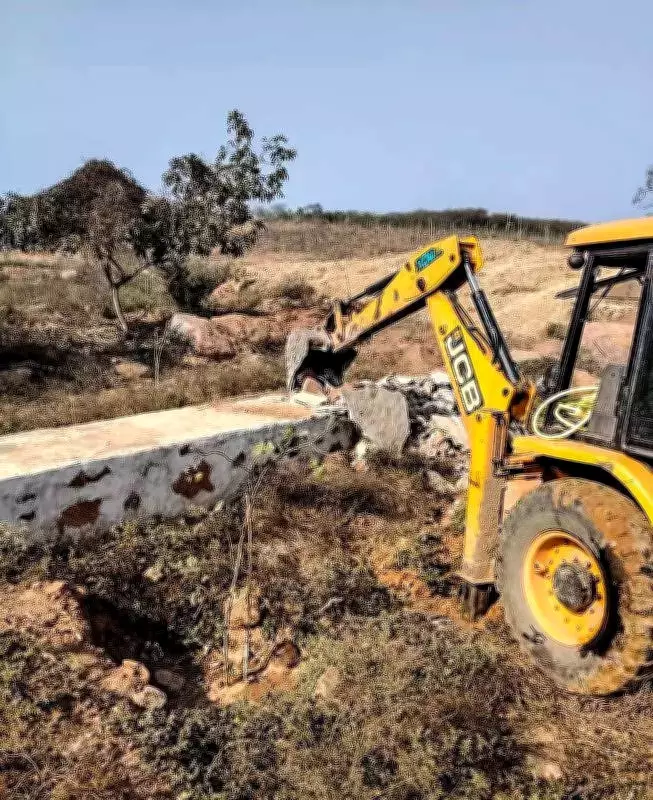
Gurgaon Forest Department Demolishes Illegal Structures in Protected Aravali Hills
The forest department in Gurgaon took decisive action on Monday by demolishing a concrete wall and two farmhouses located in the Raisina hill area. This move came after officials discovered fresh construction activities underway within the protected Aravali landscape, which is strictly regulated to preserve its ecological integrity.
Extensive Violations Uncovered
Inspections conducted by authorities revealed that the affected area spans approximately 26 acres, where extensive concretisation and the use of earthmovers were carried out without obtaining the necessary permissions. Divisional Forest Officer (Gurgaon) Raj Kumar stated that the action was initiated only after confirming that construction had resumed in clear violation of established norms.
An earthmover was deployed to dismantle the concretised wall and other structures along a narrow forest path. As a result, debris was left scattered across the hillside, highlighting the scale of the unauthorized development.

Legal Framework and Restrictions
Officials emphasized that the area falls under the Aravali Notification of 1992, which imposes strict restrictions on construction activities. This notification prohibits:
- Building roads, boundary walls, and structures without approval
- Tree felling without proper clearances
- Non-forest activities on land classified as gair mumkin pahad (uncultivable hill) without statutory permissions
The recent demolition drive follows earlier reports of large-scale violations in the Raisina region. A previous investigation had flagged a nearly 30-meter-wide road carved into the protected hills, with over 100 trees felled to clear the stretch. This road connected to an existing road below the forest belt, raising serious concerns about deeper access into the ridge and continued encroachment.
Pattern of Environmental Degradation
Earlier inspections had documented alarming signs of environmental damage, including:
- Large tracts of freshly cleared land with stripped vegetation
- Piles of excavated soil and loose rock along the ridge
- Cut branches, stumps, and exposed roots visible at multiple locations
- Fresh boundary walls and gates erected soon after vegetation clearance
At several sites, boundary walls were constructed around standing trees, effectively enclosing them within private plots. Environmentalists warn that such practices often precede complete land clearing, leading to irreversible habitat loss. Additionally, flattened hilltops with houses and multi-storey buildings under construction were recorded, indicating a systematic pattern of encroachment.
Expert Warnings and Legal Actions
Environmentalists have repeatedly cautioned that even minor alterations, such as repairing old paths with concrete, can permanently disrupt natural drainage, soil profiles, and wildlife movement. Col (retd) SS Oberoi remarked, "Despite repeated demolition drives, encroachments continue and construction returns," underscoring the persistent nature of these violations.
In 2024, the National Green Tribunal took suo motu cognisance of a report on illegal construction at Ansal's Aravali Retreat in Raisina, terming the rebuilding of demolished structures a "flagrant violation" of its earlier orders. In December 2022, the tribunal had directed the Haryana and Rajasthan governments to establish a monitoring committee and conduct periodic reviews until all encroachments were removed from the Aravali land.
This ongoing struggle highlights the critical need for stringent enforcement and continuous vigilance to protect the fragile Aravali ecosystem from further degradation.






