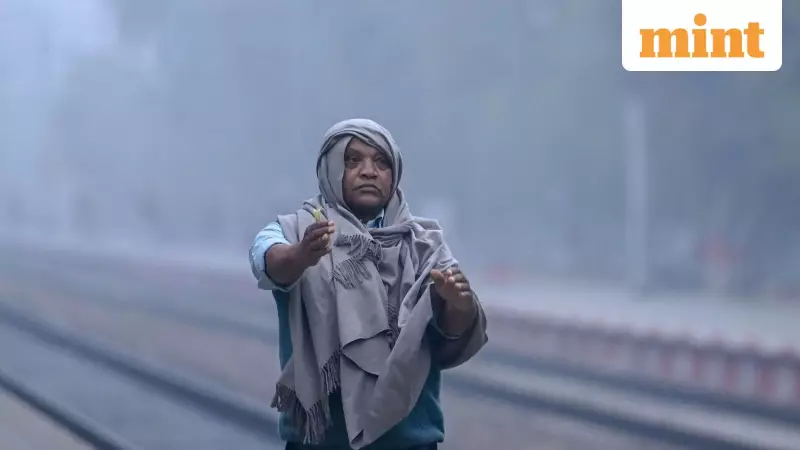
The India Meteorological Department (IMD) has issued a stark warning for large parts of North India, forecasting a significant intensification of winter conditions. The region is bracing for colder days ahead, accompanied by dense to very dense fog, which is expected to severely disrupt railway and flight operations in the coming days.
Detailed Forecast: Temperature Dip and Foggy Mornings
Mrutyunjay Mohapatra, the Director General of Meteorology at IMD, stated that monthly minimum temperatures in January 2026 are likely to be below normal over most of the country. However, some areas in northwest India, Northeastern India, and southern Peninsular India may experience above-normal temperatures.
Over the next two weeks, minimum temperatures are predicted to be 2-4°C below normal across most regions. An exception is the western Himalayan region, where temperatures could be 1-3°C above normal. The IMD has specifically warned of cold wave conditions in parts of Punjab, Haryana, North Rajasthan, North Madhya Pradesh, interior Odisha, adjoining areas of west Jharkhand, north Chhattisgarh, and south Uttar Pradesh.

The fog situation appears particularly grim. Dense to very dense fog is "very likely" during night and morning hours in Punjab, Haryana, Chandigarh, Delhi, Uttar Pradesh, Bihar, and Odisha over the next 5-7 days. Isolated pockets over Jammu, Himachal Pradesh, Uttarakhand, and Rajasthan will also be affected during the next 3-4 days. This follows weeks of cancellations and delays for multiple trains and flights due to poor visibility.
Rainfall and Rabi Crop Outlook for Winter 2026
While India as a whole is expected to receive normal rainfall (82–118% of the Long Period Average or LPA) in January, the picture for the broader winter season (January-March 2026) is different. The IMD forecasts below-normal rains across most parts of Northwest, Northeast, and Peninsular India, at less than 88% of the LPA of about 69.7mm. Some regions of Central India and Uttar Pradesh, however, may see above-normal precipitation.
This forecast has implications for agriculture, as Northwest India is a major wheat-producing zone. However, Ratan Tiwari, Director of ICAR-Indian Institute of Wheat and Barley Research (IIWBR), Karnal, noted that the deficient rainfall would not heavily impact wheat crops in the well-irrigated northwestern region, with the exception of Himachal Pradesh.
The latest government data shows a positive trend in sowing. India's rabi or winter crop sowing for 2025-26 has increased by over 687,000 hectares to 61.43 million hectares as of December 26. This marks a 1.13% rise from the previous year. The increase is driven by higher acreage for wheat, rice, pulses, and oilseeds.
Agricultural Data Shows Sowing Growth
The data released by the Ministry of Agriculture & Farmers' Welfare on December 29 reveals a detailed breakdown:
- Wheat coverage was higher by 19,000 hectares.
- Rice area saw an increase of 189,000 hectares.
- Coverage under pulses increased by 365,000 hectares, with gram recording a significant rise of 466,000 hectares.
- Oilseeds area, led by rapeseed and mustard, expanded to 9.42 million hectares, an increase of 104,000 hectares.
The data presents a mixed picture for other crops, with some pulses like field peas recording a small decline and certain cereals showing region-specific variations in sowing trends. As the winter deepens, all eyes will be on the weather's impact on both daily life and the crucial agricultural sector.