

IMD Issues 2026 Monsoon Forecast: Central India Faces High Probability of Below-Normal Rainfall
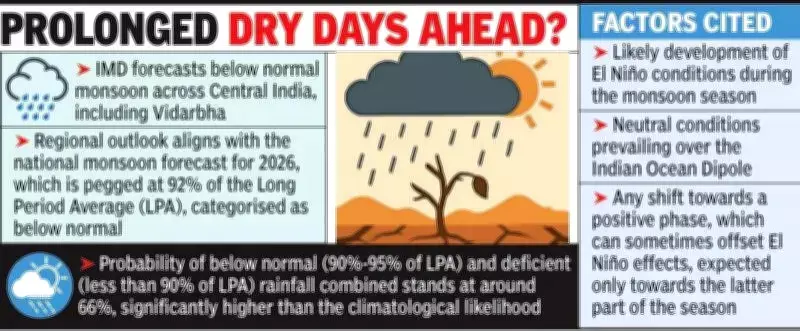
The India Meteorological Department (IMD) has released its long-range forecast for the 2026 southwest monsoon season, projecting a concerning trend of below-normal rainfall across Central India, including the Vidarbha region. This forecast, announced on Monday, covers the critical monsoon period from June to September and carries significant implications for agricultural planning and water resource management throughout the Central Indian belt.
Regional Rainfall Probability Maps Show Concerning Patterns
IMD's detailed probability maps reveal extensive areas of Central India and eastern Maharashtra shaded in yellow to orange hues, indicating a 45% to over 65% probability of below-normal rainfall during the 2026 monsoon season. The assessment specifically identifies Central India as one of the regions where deficient rainfall is most likely, even as other parts of the country—including sections of Northwest India, Northeast India, and South Peninsular India—may experience normal to above-normal precipitation.
National Forecast Aligns with Regional Outlook
The regional outlook corresponds with the national monsoon forecast for 2026, which has been estimated at 92% of the Long Period Average (LPA). This percentage categorizes the expected rainfall as below normal. IMD officials have noted that the combined probability of "below normal" rainfall (90%-95% of LPA) and "deficient" rainfall (less than 90% of LPA) stands at approximately 66%. This figure is substantially higher than the typical climatological likelihood, raising concerns about potential water scarcity and agricultural challenges.

Meteorological Factors Driving the Forecast
El Niño Development: One of the primary meteorological factors cited for this expected trend is the likely development of El Niño conditions during the 2026 monsoon season. Although the equatorial Pacific Ocean is currently in an ENSO-neutral phase, climate models indicate a strong possibility of El Niño formation. El Niño, characterized by warming of the central and eastern Pacific Ocean, frequently weakens India's monsoon system. In contrast, La Niña—cooling of the same Pacific waters—typically strengthens the Indian monsoon. The ENSO climate cycle, encompassing both El Niño and La Niña phases, exerts considerable influence on global weather patterns.
Indian Ocean Dipole (IOD) Status: Additionally, neutral conditions are prevailing over the Indian Ocean Dipole (IOD). Any potential shift toward a positive IOD phase, which can sometimes mitigate the effects of El Niño, is anticipated only toward the latter part of the 2026 monsoon season, limiting its potential offsetting impact.
Snow Cover Observations: IMD has also pointed to slightly below-normal snow cover across the Northern Hemisphere and Eurasia during January to March 2026. This observation is significant due to the inverse relationship between Northern Hemisphere snow cover and the Indian summer monsoon, potentially contributing to the forecasted rainfall patterns.
Implications for Agriculture and Water Management
The forecast is particularly critical for rain-fed agricultural regions like Vidarbha, where monsoon rainfall is essential for crop cultivation and water availability. Below-normal rainfall could lead to:
- Reduced crop yields in key agricultural areas
- Increased pressure on water resources for irrigation and drinking water
- Need for revised agricultural planning and drought management strategies
- Potential economic impacts on farming communities dependent on monsoon rains
Water management authorities and agricultural planners across Central India are expected to use this forecast to develop contingency plans and mitigation strategies ahead of the 2026 monsoon season.






