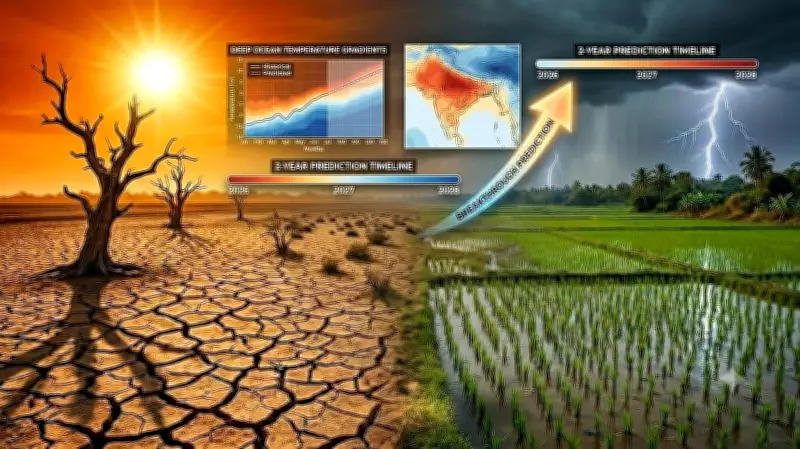
A groundbreaking study has revealed a two-year prediction model for heatwaves and extreme rainfall events in India, offering a critical window for disaster preparedness. Researchers from the Indian Institute of Technology (IIT) Delhi and the University of Reading have developed a method to forecast these dual threats with unprecedented lead time, potentially saving thousands of lives and reducing economic losses.
How the Prediction Model Works
The model leverages sea surface temperature patterns in the Pacific and Indian Oceans, particularly the El Niño Southern Oscillation (ENSO) and the Indian Ocean Dipole (IOD). By analyzing these large-scale climate drivers, the team can predict the likelihood of heatwaves and extreme monsoon rainfall up to two years in advance. According to lead researcher Dr. R. Krishnan, "This is the first time we have been able to provide actionable forecasts for both heat and rain extremes on a multi-year timescale."
The study, published in the journal Climate Dynamics, found that a combination of a positive IOD and a La Niña event significantly increases the probability of above-normal monsoon rainfall and heatwaves in central and northern India. Conversely, a negative IOD and El Niño often lead to drought conditions and fewer heatwaves.

Impact on Agriculture and Public Health
India, with its vast agricultural sector and dense population, is highly vulnerable to climate extremes. Heatwaves have claimed over 24,000 lives in the past three decades, while extreme rainfall events have caused widespread flooding and crop damage. The two-year forecast allows farmers to plan cropping patterns, governments to stockpile food and medical supplies, and disaster management agencies to pre-position resources.
"With this prediction, we can move from reactive to proactive disaster management," said Dr. M. Rajeevan, former secretary of the Ministry of Earth Sciences. "It gives us time to implement long-term adaptation strategies."
Case Studies and Validation
The researchers tested the model against historical data from 1980 to 2020, successfully predicting major events like the 2010 heatwave in northern India and the 2013 Uttarakhand floods. The model showed a 70% accuracy rate for heatwave forecasts and 65% for extreme rainfall events over a two-year horizon.
"We are now working to refine the model for regional-scale predictions," added co-author Dr. S. Singh. "This will help local authorities tailor their responses."
Policy Implications and Next Steps
The breakthrough comes as India faces increasing climate volatility. The government has already initiated discussions to integrate these forecasts into the National Disaster Management Plan. The India Meteorological Department (IMD) plans to issue experimental two-year outlooks starting in 2025.
"Early warning is our best defense against climate change," said IMD Director General Mrutyunjay Mohapatra. "This research is a game-changer for our preparedness."
The study also highlights the need for continued investment in climate monitoring infrastructure, including ocean buoys and satellite systems, to maintain forecast accuracy.