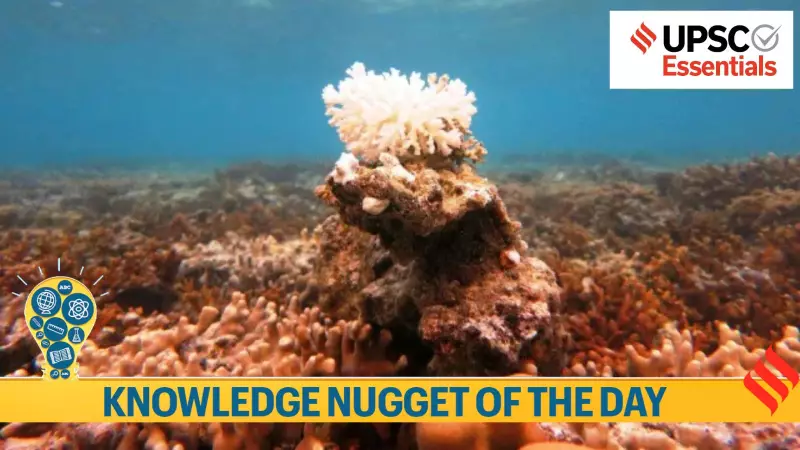
The Government of India is taking a significant step towards marine conservation with the establishment of the country's first dedicated coral reef research centre. A senior official confirmed that the National Coral Reef Research Institute (NCRRI) will soon be set up in South Andaman at an estimated cost of Rs 120 crore. This pioneering institute will serve as the central nodal agency for all coral reef research and monitoring activities across India's vast coastline.
Why Coral Reefs Matter for India and the World
Often called the "rainforests of the sea," coral reefs are ancient marine ecosystems that have existed for nearly 450 million years. They are formed by colonies of tiny animals called polyps, which secrete a hard limestone skeleton. Over millennia, these skeletons build up into the complex, three-dimensional structures we recognize as reefs.
The ecological and economic significance of these reefs is immense. A single reef can support thousands of marine species. For instance, Australia's Great Barrier Reef—the world's largest—is home to over 400 coral species, 1,500 fish species, and six of the world's seven sea turtle species. Globally, reefs provide goods and services worth approximately $375 billion annually and are a crucial source of food, income, and coastal protection for over 500 million people. They act as natural breakwaters, absorbing up to 97% of wave energy, thereby preventing erosion and protecting coastal communities from storms and floods.

The Looming Threat: Coral Bleaching
The timing of the NCRRI is critical, as coral reefs worldwide face an existential threat from coral bleaching. This phenomenon occurs when corals, stressed by changes in conditions like elevated ocean temperatures, expel the symbiotic algae (zooxanthellae) living in their tissues. These algae provide corals with both colour and essential nutrients through photosynthesis.
Without them, corals turn white and are severely weakened. While bleaching does not cause immediate death, it makes corals more susceptible to disease and reduces their reproductive capacity. Recovery is possible if the stress is short-lived, but prolonged stress leads to widespread mortality.
In April of this year, the International Coral Reef Initiative reported a devastating fourth global mass bleaching event, with around 84% of the world's reef areas affected due to abnormally high ocean temperatures. This event has now surpassed the severity of the 2014-2017 bleaching that impacted two-thirds of global reefs.
India's Coral Reefs and Conservation Measures
India, with its nearly 8,000 km coastline, has an estimated 2,375 square kilometres of coral reefs spread across four major regions:
- Gulf of Kutch
- Gulf of Mannar
- Lakshadweep Islands
- Andaman and Nicobar Islands
The government has undertaken both promotional and regulatory measures to protect these vital ecosystems. A Central Sector Scheme under the National Coastal Mission focuses on restoration and conservation at the four key sites. Regulatory protection is enforced through laws like the Coastal Regulation Zone (CRZ) Notification (2019), the Wild Life (Protection) Act, 1972, and the Biological Diversity Act, 2002.
The establishment of the NCRRI in the Andaman and Nicobar Islands represents a major upgrade in India's scientific capacity to understand, monitor, and conserve its coral reefs. By leading national research efforts, the institute will play a pivotal role in developing strategies to mitigate threats like bleaching and ensuring the long-term survival of these underwater rainforests, which are indispensable for marine biodiversity and coastal security.