

Indian Forests Projected to Store Significantly More Carbon by Century's End
A groundbreaking study has revealed that India's forests could store substantially more carbon in the coming decades, but scientists caution this trend comes with significant ecological risks. The research, conducted by the Indian Institute of Tropical Meteorology (IITM), BITS Pilani Goa, Lund University in Sweden, and other institutions, projects dramatic increases in carbon stored within living forest vegetation.
Carbon Storage Projections Across Emission Scenarios
The study utilized climate scenarios based on Intergovernmental Panel on Climate Change (IPCC) emission pathways to simulate forest responses from 1960 to 2100. Using a dynamic global vegetation model, researchers found carbon stored in trunks, branches, leaves, and roots could increase by 35% under low greenhouse gas emissions, 62% under medium emissions, and an astonishing 97% under high emissions by the year 2100.
Nationally, forest carbon density is projected to rise from a historical average of 7.74 kilograms per square meter to:

- 10.24 kg per sqm under low emissions
- 11.76 kg per sqm under medium emissions
- 13.67 kg per sqm under high emissions
The Vulnerability Paradox
While increased carbon storage might initially appear beneficial, researchers emphasize this is not entirely positive news. "It is a good thing that carbon stock is increasing, but overall it is not a positive signal," explained lead author Fitha Fathima from IITM. "Today's forests are becoming more vulnerable for the future, and the capacity of that forest is decreasing."
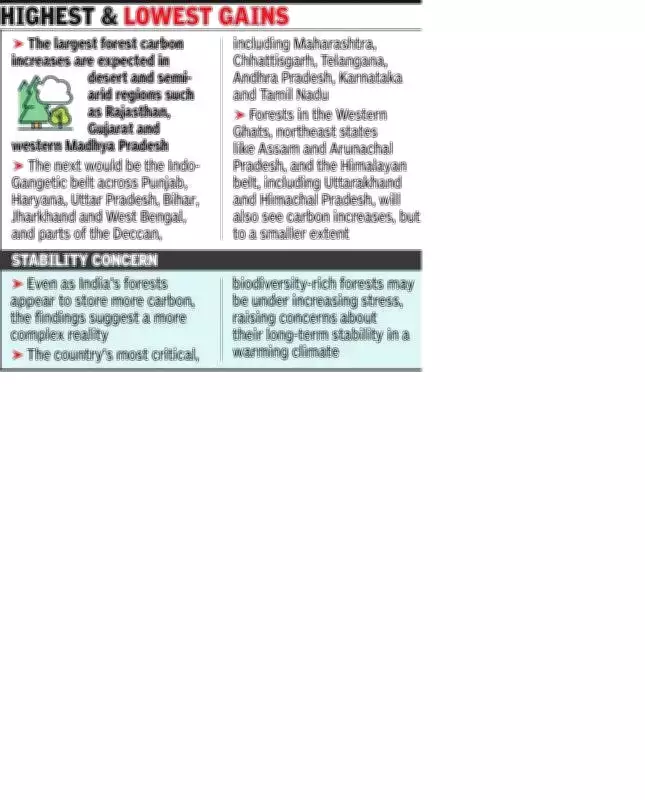
The study reveals uneven distribution of carbon gains across India's diverse forest ecosystems. The largest increases are projected in desert and semi-arid regions including Rajasthan, Gujarat, and parts of central India. Meanwhile, Western Ghats and Eastern Himalayan forests—among India's most carbon-rich ecosystems—show only modest increases.
"These regions are currently among the densest forests. If they are showing modest increases, it indicates vulnerability," Fathima noted, suggesting this signals a shift in forest health rather than simple growth.
Climate Drivers and Regional Variations
Dr. Roxy Mathew Koll, an IITM scientist involved in the research, highlighted the complex relationship between forests and climate change. "India's forests are not responding to climate change in a uniform way. Some regions may store more carbon in living biomass, but that does not mean climate change is helping forests," he stated.
The study, recently published in Environmental Research: Climate, identified rainfall as the dominant driver of forest carbon changes at the national scale, with effects appearing after a two-year lag. Temperature played a stronger role within regions, particularly under higher emission scenarios.
"A warmer world is also bringing greater risks from drought, fire and other disturbances," Dr. Koll added. "What this study shows most clearly is that rainfall matters deeply, and that future forest planning must be regional, climate-aware and rooted in risk prevention."
Scientific Limitations and Future Research
Researchers acknowledge that their projections capture only part of the complex forest dynamics picture. Rajiv Chaturvedi, a scientist at BITS Pilani Goa campus, explained: "This is one of the first forest dynamics modelling efforts from India, utilising a second generation Dynamic Global Vegetation Model (DGVM). This needs to be followed up with further modelling experiments where plot based vegetation dynamics, including nutrient limitations, could be simulated."
Pramit Deb Burman, another IITM scientist involved in the study, emphasized the changing drivers: "Deserts and semi-arid regions show the largest increase in forest carbon biomass, consistent across the emission scenarios. The growth in the Himalayan and Western Ghats remains lower. Overall, precipitation remains the major driver; its influence wanes with emissions, and warming takes over, which must be taken into consideration for nature-based mitigation management."

Uncaptured Real-World Risks
Scientists have flagged important limitations in the current modeling approach. Real-world risks including wildfires, droughts, heatwaves, and land-use changes were not fully captured in the model but could significantly affect how long forests retain accumulated carbon.
The research team emphasizes that while the projected carbon increases might seem encouraging, they mask underlying vulnerabilities in India's most critical forest ecosystems. The study calls for more sophisticated, region-specific forest management strategies that account for climate variability and increasing environmental stressors.





