

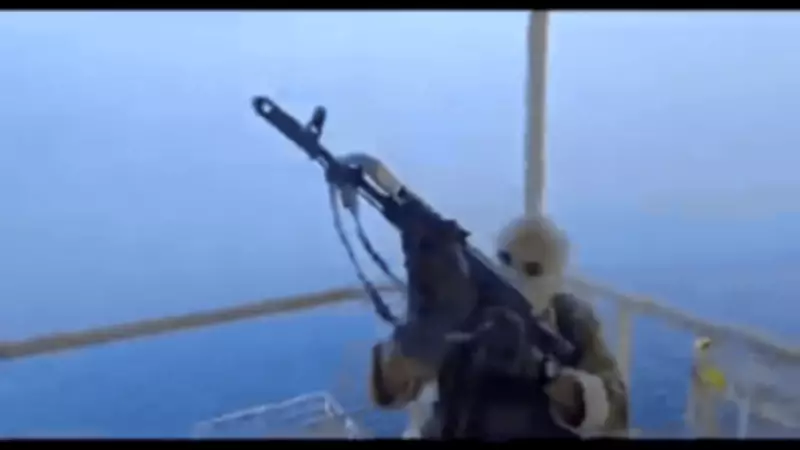
Iranian Military Releases Footage of Ship Seizure in Strait of Hormuz
The Iranian government has publicly released video footage that purportedly documents the seizure of a commercial container ship in the strategically vital Strait of Hormuz. The video, disseminated by the state-affiliated media outlet Islamic Republic of Iran Broadcasting (IRIB), provides a dramatic visual account of the incident.
Details of the Naval Operation
The footage shows armed members of the Iranian military, wearing masks, scaling the hull of a cargo vessel to gain control of the deck. This military action represents a significant escalation in regional tensions. The Islamic Revolutionary Guard Corps (IRGC), Iran's powerful military wing, claimed responsibility for the operation, stating that their forces "captured two vessels in the strait on Wednesday."
Following the boarding operations, the IRGC confirmed that the situation remained firmly under their control. They noted that "both ships were directed towards the Iranian coast" after being seized. The IRGC identified the detained ships as the "MSC-FRANCESCA" and the "EPAMINODES." In an official statement reported by IRIB, the military wing alleged that these vessels were involved in violations while transiting the strategic waterway.

The IRGC accused the crews of "tampering with navigational aid systems and jeopardising maritime security." The statement further claimed that the "MSC-FRANCESCA" belonged to the "Zionist regime" and alleged that both ships were attempting to "secretly exit the Strait of Hormuz without authorisation."
International Condemnation from Panama
In response to the seizure of vessels, Panama has issued a sharp diplomatic condemnation. The Central American nation strongly condemned the capture of the "MSC Francesca," describing the capture of a vessel sailing under its flag as "illegal." Panama's Ministry of Foreign Affairs clarified that while the ship is Italian-owned, it is registered under the Panamanian flag.
"The ship was transiting the Strait of Hormuz when it was seized and forcibly taken to Iranian territorial waters," the ministry stated in an official release. Officials further warned that Tehran's actions pose "a serious threat to maritime security" and labelled the incident an "unnecessary escalation" at a time when the international community seeks to keep the waterway open without "threats or blackmail of any kind."
Broader Diplomatic Context and Tensions
This naval confrontation surfaced just hours after US President Donald Trump announced an indefinite extension of a temporary ceasefire in the region. In an interview with CNBC, Trump issued a direct appeal for a diplomatic breakthrough, suggesting Iran could secure a prosperous future through a new agreement.
The President remarked, "Iran can get themselves on a very good footing if they make a deal," noting the potential for a complete transformation of Tehran's circumstances. Despite maintaining a naval blockade, Trump urged the Iranian government to adopt a pragmatic strategy, adding, "They have to use reason and they have to use common sense, and they can get themselves into a great position to make themselves into a great country."
However, this gesture has been met with considerable scepticism in Tehran. Iranian President Masoud Pezeshkian criticised the United States for what he termed "hypocritical" and contradictory behaviour. In a post on social media platform X, Pezeshkian wrote, "The Islamic Republic of Iran has always welcomed and continues to welcome dialogue and agreement. Bad faith, siege, and threats are the main obstacles to genuine negotiation." He further accused Washington of a contradiction between its claims and its actions.
Uncertain Path Forward for Diplomacy
While media reports indicated that Trump views a new round of talks as "possible" within a window of 36 to 72 hours, the path forward remains clouded with uncertainty. Iranian foreign ministry spokesperson Esmaeil Baqaei stated that Tehran has not yet reached a final decision on participating in the upcoming round of mediated discussions.

The seizure of commercial vessels in one of the world's most critical maritime chokepoints represents a serious escalation that threatens global trade routes and regional stability. The incident highlights the ongoing tensions between Iran and Western nations, with Panama's strong condemnation adding another layer to the complex diplomatic landscape.
As the situation develops, international observers are closely monitoring how this incident will impact broader negotiations and whether it will lead to further military confrontations or diplomatic resolutions in the volatile region.





