

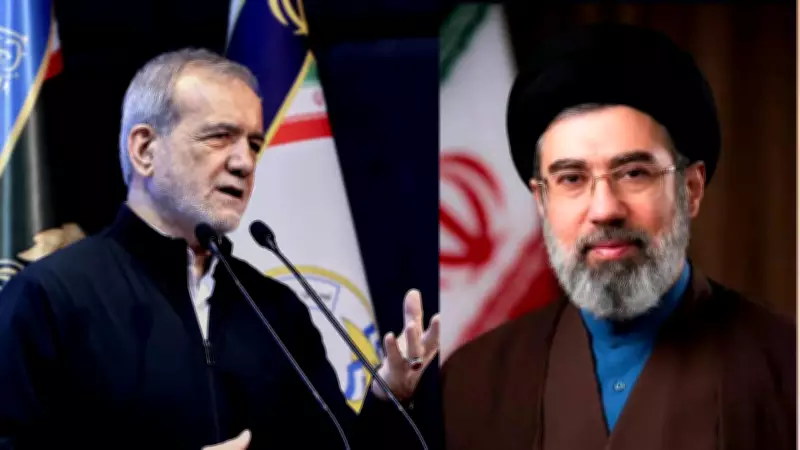
Iran's Leadership Faces Mounting Internal Strain Amid Escalating Conflict
As the military confrontation involving the United States, Israel, and Iran continues into its second week, significant cracks are appearing within Iran's political and security establishment. Despite public declarations rejecting Washington's demands for "unconditional surrender" and vows to persist in hostilities, the Iranian leadership is grappling with visible internal discord that threatens to undermine its wartime unity.
The Catalyst: Ayatollah Khamenei's Assassination and Leadership Void
The death of Iran's supreme leader Ayatollah Ali Khamenei in a joint US-Israeli strike on February 28 triggered immediate chaos and a precarious leadership transition. This pivotal event forced Tehran to activate constitutional provisions, establishing a three-member interim leadership council to exercise supreme authority until a permanent successor could be determined.
The council comprised President Masoud Pezeshkian, judiciary chief Gholam-Hossein Mohseni-Ejei, and senior cleric Ayatollah Alireza Arafi. Their initial response was characteristically defiant, promising swift retaliation and launching coordinated missile and drone attacks against Israeli and American targets throughout the region.

These strikes extended beyond military installations to include critical infrastructure in Gulf nations such as airports, oil refineries, and hotels in Bahrain, Qatar, Saudi Arabia, and the United Arab Emirates, demonstrating Iran's willingness to expand the conflict's geographical scope.
President Pezeshkian's Controversial Apology and Swift Backlash
The first public indication of serious internal disagreement emerged on March 7 when President Pezeshkian delivered a pre-recorded state television address that included an unprecedented apology to neighboring countries affected by Iran's retaliatory strikes.
"I personally apologise to neighbouring countries that were attacked by Iran. Our commanders, leaders and loved ones lost their lives due to the brutal aggression that took place," Pezeshkian stated, adding, "We didn't intend to violate neighbouring countries. As I have said many times, they are our brothers."
This conciliatory stance provoked immediate and fierce criticism from hardline factions within Iran's political and security apparatus:
- Parliament speaker Mohammad Bagher Ghalibaf declared that "as long as the presence of US bases in the region continues, the countries will not enjoy peace."
- Lawmaker Hamid Rasaei condemned Pezeshkian's position as "unprofessional, weak and unacceptable," arguing that countries hosting American military installations should be apologizing to Iran instead.
- Judiciary chief Mohseni-Ejei directly contradicted the president, asserting that regional states had permitted their territories to be used for attacks against Iran and vowing that "heavy strikes on those targets will continue."
Facing this intense backlash, Pezeshkian quickly revised his position, claiming on social media that Iran "had not attacked our friendly and neighbouring countries; rather, we have targeted US military bases, facilities, and installations in the region." In a subsequent television appearance on March 8, he argued that his earlier remarks had been "misinterpreted by the enemy that seeks to sow division with neighbours."
Contentious Leadership Transition: Mojtaba Khamenei's Appointment
Amid this internal turmoil, Iran's leadership transition took another controversial turn with the selection of Mojtaba Khamenei as the new supreme leader. This decision, strongly advocated by hardline clerics and the Islamic Revolutionary Guard Corps (IRGC), faced significant resistance from reformist and moderate elements within the establishment.
Critics raised multiple objections to Mojtaba Khamenei's elevation:

- Concerns about his insufficient senior clerical standing and limited political experience compared to traditional expectations for the position.
- Arguments that appointing the son of the former supreme leader contradicted the foundational ideals of the 1979 Islamic Revolution, which overthrew the hereditary Pahlavi monarchy and explicitly rejected dynastic rule.
- Some factions within Tehran's power structure advocated for extending the interim council's authority rather than rushing the succession process, with security council chief Ali Larijani reportedly leading this position.
The IRGC's Expanding Wartime Influence and Autonomy
Despite these objections, Mojtaba Khamenei's longstanding and deep connections with the Revolutionary Guards proved decisive in securing his position. Reports indicate he had cultivated substantial influence within IRGC command networks, participating in shaping senior appointments and critical security decisions even before his formal elevation.
The ongoing conflict has significantly strengthened the Guards' position within Iran's political system, granting the organization unprecedented autonomy in military strategy formulation and execution. In several instances, the IRGC has effectively overshadowed the traditional clerical leadership in directing wartime operations.
Analysts observing these developments note that the conflict has clarified where genuine authority resides within Iran's power structure. "Wartime tends to clarify power structures, and in this case the decisive voice is not that of the civilian leadership but of the IRGC," Middle East Institute fellow Alex Vatanka observed, highlighting the shifting balance of power.
Uncertain Leadership Amid Sustained Military Pressure
As Iran continues to face relentless military pressure from combined US and Israeli operations, the new supreme leader's immediate challenge involves consolidating his authority while navigating a conflict that has already exposed profound divisions within Tehran's leadership structure.
The emerging fault lines between moderates, clerics, and hardline security factions—highlighted by debates over regional attacks, the leadership succession, and the IRGC's expanding role—suggest growing disagreements about how Iran should prosecute the war despite surface-level unity in rejecting American and Israeli demands.
These internal strains raise critical questions about Iran's strategic coherence and decision-making processes as the conflict enters a potentially more dangerous phase, with the Revolutionary Guards warning that continued "hostile actions" could make all US and Israeli military bases and interests across the region "primary targets" for Iranian retaliation.





