

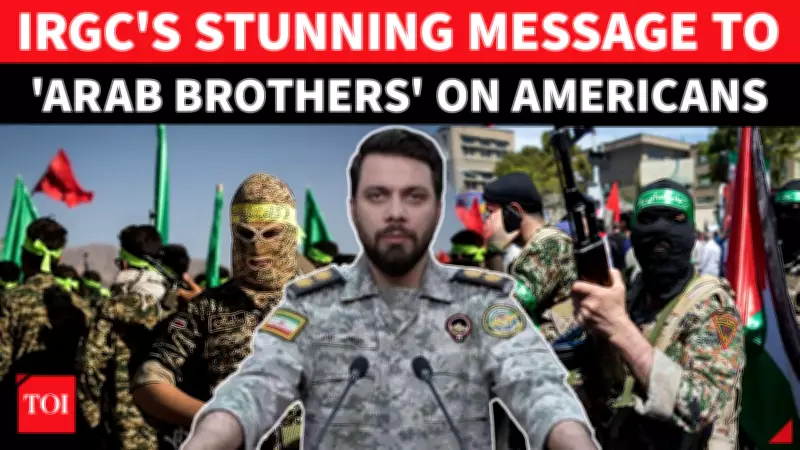
IRGC's Unprecedented Call to Arab Citizens: Report US Troop Locations
In a highly unusual public appeal, Iran's Islamic Revolutionary Guard Corps (IRGC) has directly addressed citizens across several Arab nations, urging them to report the precise locations of United States military forces stationed throughout the Middle East. This bold statement, issued recently, marks a significant escalation in the ongoing intelligence and propaganda war between Tehran and Washington.
Details of the IRGC's Directive
The IRGC's message claims that approximately 11,000 American troops are currently deployed across the region. According to the statement, some of these personnel are allegedly residing in hotels and private accommodations rather than traditional military bases. The Guard Corps explicitly calls on local residents not to host U.S. military members and instead to actively gather and transmit information regarding their whereabouts.
The preferred method for submitting this intelligence, as outlined by the IRGC, is through the encrypted messaging application Telegram. This platform is widely used in the region and offers a degree of anonymity, facilitating the covert collection of sensitive data.

Explicit Warnings and Strategic Implications
Accompanying the call for information is a stark warning from Iranian authorities. The statement declares that American forces will be targeted, and it cautions civilians to maintain a safe distance from any locations where U.S. personnel are suspected to be present. This advisory is clearly intended to mitigate potential collateral damage while underscoring the seriousness of Iran's intent.
This public plea underscores the rapidly intensifying tensions and the broadening scope of the intelligence conflict engulfing the Middle East. By appealing directly to the Arab populace, the IRGC is attempting to leverage local knowledge and potentially sow distrust between regional governments and their American allies. The move represents a calculated effort to turn civilian networks into an extension of Iran's intelligence-gathering apparatus.
Broader Context of Regional Instability
The IRGC's announcement occurs against a backdrop of sustained regional volatility. Recent months have witnessed a series of confrontations and proxy engagements involving Iran, its allied militias, the United States, and Israel. This directive can be interpreted as both a psychological operation and a practical measure to enhance situational awareness for potential future operations.
Analysts suggest that such a public call for intelligence is rare and indicates a high level of confidence in certain sympathetic segments of the population. It also reflects the asymmetric warfare strategies often employed in the region, where information and perception are as critical as military hardware.
The international community is closely monitoring these developments, concerned that such rhetoric and actions could precipitate a dangerous miscalculation or direct confrontation. The explicit mention of targeting U.S. forces raises the stakes significantly, potentially altering the risk calculus for American deployments across the Middle East.






