

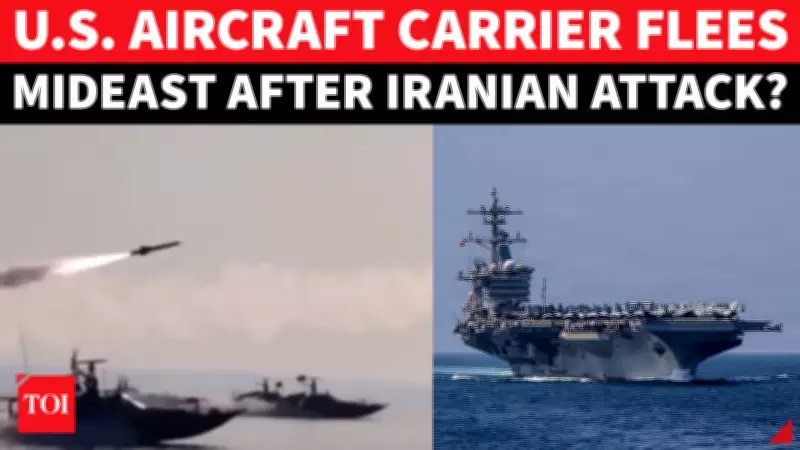
IRGC Claims US Aircraft Carrier Retreating After Attack By Iranian Navy
In a dramatic escalation of maritime tensions, the Islamic Revolutionary Guard Corps (IRGC) of Iran has asserted that it successfully targeted the US aircraft carrier USS Abraham Lincoln with a coordinated missile and drone assault in the Sea of Oman. According to IRGC statements, this strike inflicted substantial damage on the 100,000-ton warship, compelling it to withdraw from the region under duress. The IRGC described the operation as a significant military achievement, highlighting their naval capabilities in the strategically vital waters.
US Central Command Firmly Rejects Iranian Claims
Contrary to the IRGC's assertions, the United States Central Command has categorically denied any such attack occurred. Officials released photographic evidence depicting the USS Abraham Lincoln and its accompanying carrier strike group actively engaged in routine operations as part of Operation Epic Fury. The US military emphasized that the carrier remains fully operational and undamaged, dismissing the Iranian claims as baseless propaganda aimed at inflaming regional tensions.
The conflicting narratives have sparked a fresh war of words between Tehran and Washington, with each side presenting starkly different accounts of the incident. This development occurs against a backdrop of heightened geopolitical friction in the Middle East, where naval confrontations and rhetorical exchanges have become increasingly frequent.

Background of Rising Tensions in the Region
The Sea of Oman has long been a flashpoint for international disputes, given its critical role in global oil shipping lanes and military strategy. Recent months have seen a series of provocative actions and statements from both Iranian and US forces, including previous threats and minor skirmishes. Analysts suggest that such claims, whether factual or fabricated, are often used as tools of psychological warfare to test adversaries' responses and project strength domestically.
This incident underscores the volatile nature of US-Iran relations, which have been strained by issues ranging from nuclear negotiations to regional proxy conflicts. The IRGC's bold claim, if unverified, may be intended to bolster Iran's image as a formidable naval power capable of challenging US military dominance in the area.
Potential Implications for Global Security
Should the IRGC's allegations prove accurate, the implications could be severe, potentially triggering a direct military confrontation with far-reaching consequences. However, given the US denial and provided evidence, the current assessment leans towards the event being a misinformation campaign. Nonetheless, such incidents risk miscalculation and escalation, threatening stability in an already turbulent region.
International observers are closely monitoring the situation, urging both parties to exercise restraint and adhere to diplomatic channels. The veracity of the IRGC's claims remains unconfirmed by independent sources, leaving the global community to navigate a landscape of competing narratives and heightened alertness.






