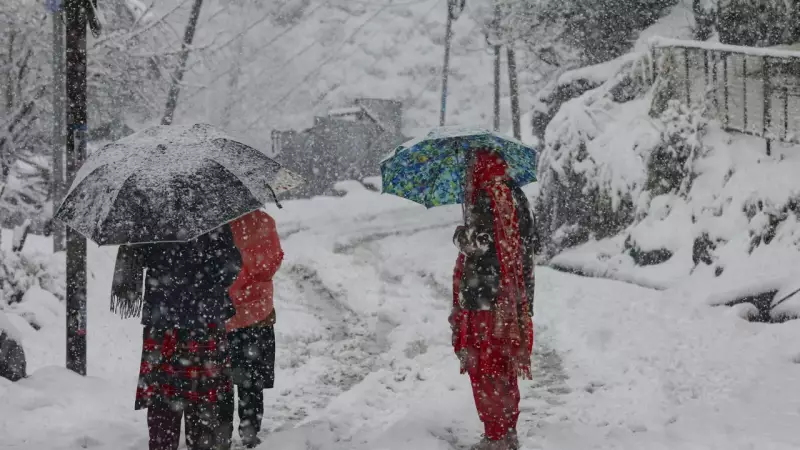
Severe snowfall accompanied by savage winds reaching speeds of up to 155 kilometers per hour battered the union territory of Jammu and Kashmir on Friday, causing widespread disruption across the region. The extreme weather conditions led to the blocking of major highways, cancellation of flights, closure of educational institutions, disruption of power supply, damage to homes, and the forced suspension of the revered Vaishno Devi pilgrimage.
Valley and Jammu Region Bear the Brunt
In the Kashmir Valley, the India Meteorological Department reported significant snowfall accumulations as the weather system, fueled by western disturbances, began its onslaught late Thursday night. Shopian received 55 centimeters of snow, Gulmarg 45 centimeters, Kupwara 20 centimeters, Pahalgam 17 centimeters, Banihal 16 centimeters, and Sonamarg 15 centimeters.
In the Jammu region, the Trikuta Hills, which house the sacred cave shrine of Shri Mata Vaishno Devi, witnessed the first snowfall of the season. Similar snowfall was reported in Doda, Kishtwar, Ramban, and Poonch districts. A government official in Jammu confirmed that light to moderate rains lashed several other areas across the region.

Transportation and Infrastructure Severely Impacted
Vehicular movement was completely halted in both directions on the crucial Jammu-Srinagar National Highway due to fresh snowfall around the Navyug Tunnel. Several other roads across the territory were also blocked, isolating many communities.
At Srinagar airport, all flight operations were suspended on Friday. IndiGo Airlines confirmed that both take-offs and landings had been canceled due to the heavy snowfall. The airline stated it is closely monitoring the weather situation and will resume operations as soon as conditions permit.
Power Grid Crippled and Structural Damage Reported
The power and transmission infrastructure suffered extensive damage. Chief Minister Omar Abdullah, who also holds the power portfolio, warned of massive losses. He highlighted that the active power load in the Valley had plummeted to less than 100 megawatts on Friday, compared to the usual 1700 megawatts, due to the gusty winds disrupting the entire transmission system.
Mehmood Ahmad Shah, Managing Director of the Kashmir Power Distribution Corporation, reported that several roofs collapsed directly onto transmission lines in Srinagar and other districts, severely impacting electricity supply to residents and businesses.
The IMD recorded extreme wind speeds across multiple locations: 155 kilometers per hour in Shopian, 80 kilometers per hour in Poonch, 76 kilometers per hour in Reasi, 63 kilometers per hour in Jammu, and 84 kilometers per hour in Srinagar. In Srinagar's busy Lal Chowk area, battered roof sheets fell and piled up near the Clock Tower, bringing traffic to a complete standstill. Similar scenes of structural damage were reported from various other areas across the Valley.
Expert Analysis on Structural Vulnerabilities
Former Kashmir chief town planner Iftikhar Hakeem attributed part of the damage to improper construction, noting that many roofs were not anchored properly to the walls. Architect Sameer Hamdani echoed this concern, explaining that numerous roofs are constructed as temporary structures, particularly in shopping complexes where owners may intend to add additional floors in the future.
Safety Measures and Rescue Operations
Authorities in Jammu ordered the closure of schools in Rajouri, Reasi, Poonch, and Udhampur districts to ensure the safety of students and staff. In a daring three-hour mission, police rescued twelve people, including children, who were stranded in heavy snow in the Chochru Galla area of Udhampur.
Additionally, army troopers assisted civilians who were stuck in buses, trucks, and other vehicles in the Tota Gali area of Poonch following the heavy snowfall.
More Severe Weather Forecasted
The rough weather spell is expected to linger. According to Mukhtar Ahmad, director of the Meteorological Department in Srinagar, a second burst of western disturbance is likely to affect the region on January 26. This is expected to be preceded by light to heavy rainfall on January 24 and 25, potentially exacerbating the already challenging situation.