

Kolkata Emerges as India's Least Congested Metro City, Yet Grapples with Highest Vehicular Pollution
Kolkata has been identified as the least congested among India's major metropolitan cities, according to a comprehensive new analysis by the Centre for Science and Environment (CSE). However, this positive finding is starkly contrasted by the city simultaneously recording the highest exposure to vehicular air pollution across the nation's urban centers.
Decoding the Congestion Paradox: Public Transport's Crucial Role
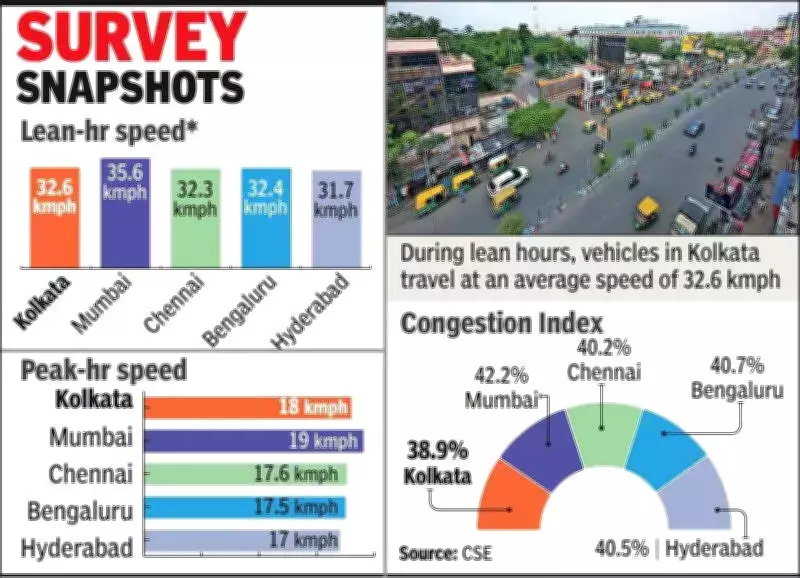
The study attributes Kolkata's relatively lower congestion levels primarily to its weakened yet still functional public transportation network, which continues to absorb a substantial portion of daily commuting demands. The research employs a congestion index measuring the percentage drop in average vehicle speeds between lean and peak hours.
Kolkata's congestion index stands at 38.9%, calculated from lean-hour speeds of 32.6 kmph dropping to 18 kmph during peak periods. This performance surpasses other metropolitan counterparts including Mumbai, Chennai, Bengaluru, and Hyderabad. Excluding Delhi from comparison, Kolkata also achieves the second-highest average peak-hour speed among major Indian metros, highlighting the enduring significance of mass transit systems.

Urban Design Challenges and Rising Vehicle Ownership
Despite favorable congestion metrics, Kolkata's peak hours often resemble slow-moving parking lots where autos, private cars, two-wheelers, and buses fiercely compete for limited road space. On-street parking frequently occupies between one-third to half of available carriageway width.
"Congestion patterns in Kolkata are shaped as much by urban design and parking practices as by sheer traffic volume," explained CSE Executive Director Anumita Roychowdhury.
Vehicle ownership has escalated dramatically between 2016 and 2024, with four-wheeler registrations increasing five-fold and two-wheeler numbers surging more than twelve-fold. Remarkably, despite this explosive growth, car trips constitute only 5.3% of all journeys undertaken in the city.
Evolving Travel Patterns and Pollution Paradox
Kolkata's travel behavior has undergone significant transformation. The average number of trips per person daily has risen from 1.5 in 2001 to 1.8 in 2025, while average trip length has decreased from 8 km to 6.5 km. Notably, 56% of all trips remain within a 5-kilometer radius.
The report underscores a troubling contradiction: while congestion is relatively controlled, Kolkata suffers the highest exposure to vehicular air pollution among major Indian cities. CSE analysis indicates this paradox stems from heavy reliance on road-based transport, constrained road infrastructure, and extensive parking obstructions rather than vehicle ownership alone. Furthermore, the gradual weakening of public transport systems is accelerating the shift toward personalized vehicles.
Revival Solutions: Trams, Electric Mobility, and Policy Interventions
To combat pollution and prevent future congestion escalation, CSE advocates for urgent revitalization of Kolkata's historic tram network—India's sole operational tram system and the city's original zero-emission transportation mode.
The study proposes a multi-pronged strategy combining tram restoration with electric bus integration, establishment of low-emission zones, and expansion of pedestrian and cycling infrastructure. Such measures could simultaneously deliver cleaner air and smoother traffic flow.
Additional recommendations include curbing personal vehicle usage through comprehensive parking management systems, variable parking pricing structures, congestion charges, and strategic road pricing mechanisms to incentivize sustainable mobility choices.






