

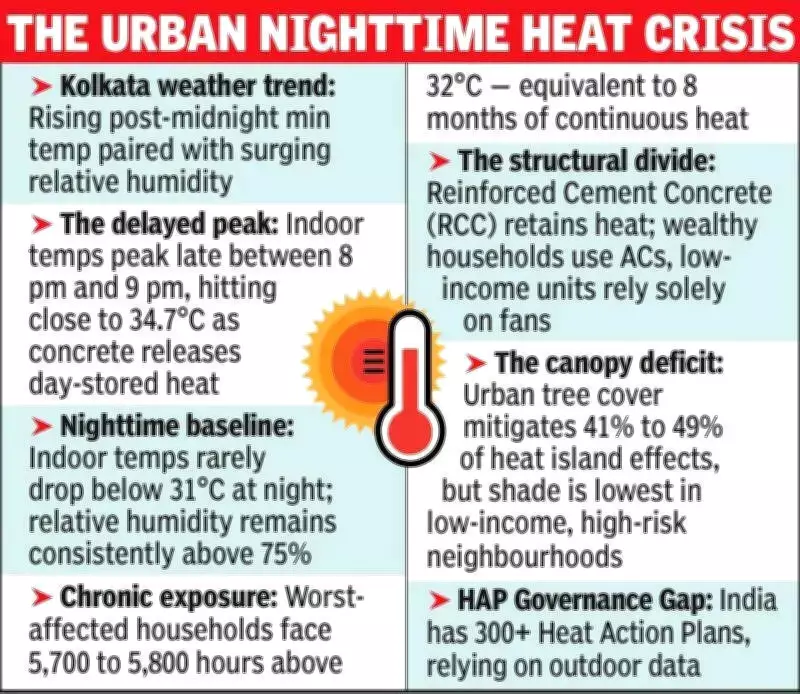
Kolkata is grappling with a severe nighttime heat stress crisis, driven by a toxic combination of climbing midnight temperatures and relentless relative humidity. The city's low-income populations are bearing the brunt of this worsening trend, as recovery from daytime heat becomes nearly impossible.
IMD Forecast and Heat Index
The India Meteorological Department (IMD) has forecast that Kolkata's minimum temperatures, typically recorded past midnight, will rise further in the coming days. Combined with high humidity, this trend is significantly driving up the city's heat index, making it difficult for vulnerable residents to cool down overnight.
Study Findings on Nighttime Thermal Stress
This local crisis reflects findings from a landmark study released by the research and advocacy group Climate Trends at the India Heat Summit 2026. Titled Nighttime Thermal Stress in Low and Middle Income Housing in India, the study used high-resolution sensors to monitor indoor conditions between October 2025 and April 2026.

While the field research focused on baseline data from urban neighbourhoods in Chennai, a coastal city sharing Kolkata's high-humidity, high-heat profile, the structural revelations directly map onto Kolkata's dense, low-income settlements. The data exposes a dangerous reality: standard concrete buildings act as thermal sponges. Indoor spaces did not cool down when the sun set; instead, they hit peak temperatures between 8 pm and 9 pm, radiating heat trapped by reinforced cement concrete (RCC) roofs and walls during the day.
Aarti Khosla, founder and director of Climate Trends, said: "Indoor temperatures regularly breached 32 degrees Celsius, with nighttime temperatures rarely dropping below 30 degrees Celsius. Coupled with relative humidity levels consistently hovering above 75 percent, the indoor environment effectively blocks the human body's natural ability to cool itself through sweating."
Socioeconomic Divide in Heat Coping Capacity
The study highlights a stark socioeconomic divide: income determines a household's capacity to cope with heat, not its exposure to it. While high-income residents rely on air conditioning to artificially break the thermal cycle, low-income families are left with only ceiling fans, which merely circulate hot, humid indoor air.
Pralhad Joshi, Union minister for new and renewable energy, speaking at the summit, said: "Heat stress has emerged as one of the defining challenges of our times."
Outdoor Ecological Deficit
Compounding this indoor structural trap is an outdoor ecological deficit. A parallel study published in Nature Communications revealed that while urban tree cover could halve the intense urban heat island effect, canopy distribution remains deeply inequitable. Densely populated, low-income urban pockets feature the thinnest tree cover globally, depriving the most vulnerable citizens of natural shade and cooling.
Health Impacts and Policy Calls
As Kolkata's post-midnight temperatures continue their upward trajectory, public health experts warned of widespread sleep disruption, persistent fatigue, and rising heat-related ailments. Current urban Heat Action Plans (HAPs) across India trigger emergency responses solely based on daytime, outdoor meteorological thresholds, though Kolkata is yet to have its HAP in place.
Experts are now calling for a major policy overhaul to mandate indoor thermal monitoring and subsidise passive cooling retrofits, such as cool-roof coatings, to protect citizens behind closed doors.






