

Kolkata's Winter Air Quality Plummets into Persistent Danger Zone
Kolkata's winter air quality has been consistently slipping into hazardous territory since January 2024, according to a comprehensive new analysis. The study reveals that the city has experienced near-continuous violations of national air-quality standards for both fine particulate matter (PM2.5) and coarse particulate matter (PM10) throughout recent winter months.
Structural Pollution Patterns Emerge
The research conducted by Respirer Living Sciences utilized station-level data from their AtlasAQ platform to meticulously track pollution trends, identify recurring hotspots, and map hourly patterns. The central finding presents a grim reality: winter pollution in Kolkata has transformed from occasional episodes to a structural and predictable phenomenon.
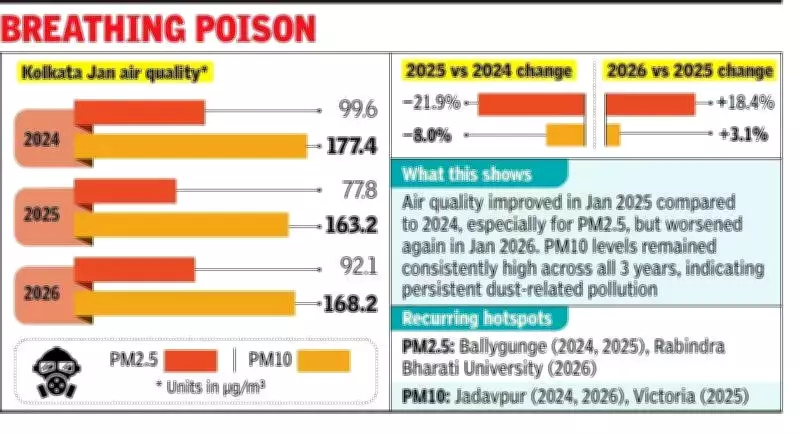
"In January 2026, both PM2.5 and PM10 crossed national safety limits on all 31 days in Kolkata," stated Ronak Sutaria, founder and CEO of Respirer Living Sciences. "This demonstrates that winter pollution here is persistent and deeply embedded in the city's environmental fabric. While 2025 showed a brief improvement, January 2026 completely reversed those gains, with city-average PM2.5 climbing back to over 92 micrograms per cubic metre."

Alarming Pollution Trends and Rebound Effects
According to the detailed analysis, PM2.5 levels experienced a significant decline of nearly 22% in January 2025 compared to 2024 levels. However, this improvement proved temporary, as PM2.5 rebounded dramatically by more than 18% in 2026. PM10 pollution followed a similar concerning pattern, with a modest reduction in 2025 followed by a substantial increase the following year.
Across all three years examined, PM10 levels remained dangerously elevated for almost the entire month, rarely descending into cleaner air quality categories that would be considered safe for public health.
Predictable Daily Pollution Rhythm
The study uncovered a strikingly consistent daily pollution pattern that adds another layer of concern. Both PM2.5 and PM10 concentrations peak precisely at 11 PM every January, with the highest pollution levels consistently clustering between 10 PM and midnight. This late-night spike strongly suggests pollution accumulation driven primarily by winter meteorological conditions rather than just fresh emissions from daytime activities.
"The fact that pollution peaks so reliably at night points directly to trapped air and poor atmospheric dispersion," Sutaria explained. "For Kolkata residents, particularly vulnerable populations including children, the elderly, and individuals with pre-existing respiratory conditions, there were virtually no safe breathing days throughout these winter periods."
Persistent Geographic Hotspots Identified
Another critical insight from the analysis was the persistence of specific geographic hotspots across multiple years. Neighborhoods including Ballygunge, Jadavpur, and the area surrounding Rabindra Bharati University repeatedly recorded the highest pollution levels year after year. While PM2.5 hotspots showed some minor shifting, PM10 hotspots demonstrated remarkable consistency, highlighting the significant role of dust, ongoing construction activities, and road resuspension in maintaining these dangerous pollution levels.
"These are not random or isolated pollution spikes," Sutaria emphasized. "They represent location-specific exposures that demand targeted, seasonal interventions. Winter air quality in Kolkata needs to be treated as a continuous public-health risk requiring systematic management, rather than an occasional emergency requiring temporary responses."
The comprehensive analysis paints a troubling picture of Kolkata's winter air quality crisis, revealing structural pollution patterns, predictable daily rhythms, and persistent geographic hotspots that collectively create a continuous public health threat during the winter months.






