

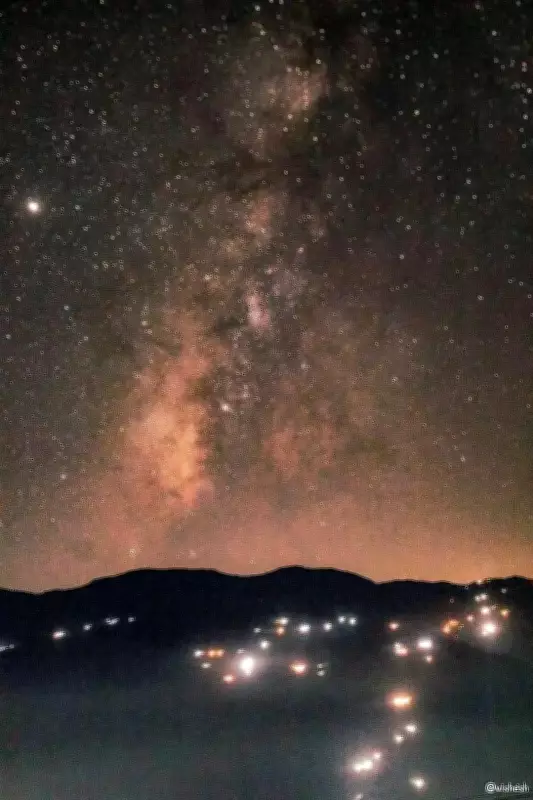
Nainital: For generations, the pristine, ink-black skies over Uttarakhand's Central Himalayas have served as humanity's silent window into the deep universe. Towering high above the clouds, these peaks host some of India's most advanced astronomical facilities. Today, this natural sanctuary is increasingly under threat from unchecked light pollution driven by rapid commercial tourism, expanding infrastructure, and urban sprawl.
The Retreat from Manora Peak
For decades, the Aryabhatta Research Institute of Observational Sciences (ARIES) operated its historic 104-cm Sampurnanand Optical Telescope at Manora Peak near Nainital. As the hill town swelled with resorts and high-intensity commercial streetlights, the site became too bright for cutting-edge optical astronomy. This forced scientists to retreat deeper into the mountains, moving major operations to Devasthal in the remote Okhalkanda block.
Devasthal: A New Frontier Under Siege
At 2,450 meters above sea level, Devasthal offers exceptionally clear, dark skies. Today, it hosts Asia's largest ground-based optical telescope—the 3.6-meter Devasthal Optical Telescope (DOT)—alongside a 1.3-meter fast optical telescope and a unique 4-meter liquid mirror telescope. These highly sophisticated instruments pierce deep space to capture faint light from quasars and supernovae. Yet, history threatens to repeat itself. Encroaching light from nearby tourism hubs like Bhimtal and Dhanachuli is already bleeding into the sanctuary. Local astrophotographers Vishesh Mishra and Pramod Singh Khati note that long-exposure photos of the Milky Way now frequently capture a stubborn, amber-white haze along the horizon, forcing them to rely heavily on light-suppression filters and digital editing.

Balancing Safety and Darkness
Protecting the dark isn't as simple as flipping a switch. In remote Himalayan villages, outdoor lighting is an essential safety measure. “Lighting cannot be entirely restricted in remote areas, where it plays an important role in ensuring human safety, particularly in regions with documented incidents of leopard attacks,” Khati explains.
The core issue lies in a lack of regulation for commercial properties and minimal public awareness. While astro-tourism is booming in Uttarakhand, light pollution remains almost entirely absent from environmental policy discussions. According to ARIES director Manish K Naja, the consequences extend far beyond astronomy—excessive artificial glare actively disrupts fragile nocturnal ecosystems, scattering migratory birds and altering insect behavior.
A Call for a Dark Sky Reserve
To strike a balance, scientists are advocating for a legally protected Dark Sky Reserve around the Devasthal Observatory, modeled after India's first such reserve at Hanle in Ladakh. A framework like the one in Hanle would allow Uttarakhand to enjoy the socio-economic benefits of thriving astro-tourism while enforcing vital regulations, such as mandating shielded, downward-facing LED lights in neighboring village councils.
Without swift conservation measures, the Central Himalayas risk losing one of their most valuable natural assets, forever blurring the vital window through which humanity explores the universe.






