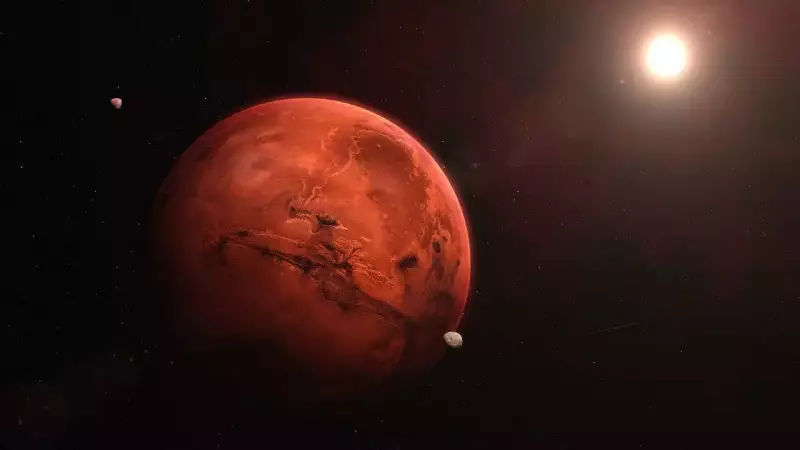
The notion seems lifted from science fiction: Could the distant, dusty planet of Mars be exerting control over Earth's complex climate systems? At first glance, it clashes with our everyday understanding of climate change, which revolves around industrial emissions, deforestation, and oceanic health. Yet, science reveals a more nuanced, grander cosmic dance where Mars plays a minor, but mathematically significant, part.
The Cosmic Clockwork: Gravity's Patient Hand
Earth does not exist in isolation. It is a participant in a vast gravitational ballet within our solar system, where every celestial body, from the largest planet to the smallest asteroid, exerts a constant, subtle pull on the others. This is where Mars enters the scientific narrative—not as a dominant controller, but as one of many gravitational influences that gently modify Earth's journey around the Sun over immense stretches of time.
Evidence for this has been building for decades. By examining deep ice cores and layers of ocean sediment, scientists identified repeating climate patterns spanning hundreds of thousands of years. These rhythms could not be explained by volcanic activity or solar variations alone. Instead, they aligned perfectly with predictable, slow changes in Earth's orbital path and axial tilt, changes driven by the collective gravity of the solar system. A pivotal peer-reviewed study in the journal 'Science' confirmed that major climatic shifts correlate with these astronomical cycles.

What Mars Does and Does Not Do
It is crucial to clarify the mechanism. Mars is not heating our planet, altering our atmosphere, or connected by any mysterious energy beam. Its influence is purely gravitational, and on human timescales, it is exceptionally weak. However, weak does not mean insignificant when amplified over tens of thousands or millions of years.
Each planet tugs on Earth. Over epic timescales, these persistent tugs from Mars and other bodies gradually alter the shape of Earth's orbit (its eccentricity) and the behavior of its rotational axis (its tilt and wobble). Earth's climate is exquisitely sensitive to how sunlight is distributed across the globe. Minor orbital shifts can determine whether summers in polar regions remain cool enough to preserve ice or become warm enough to trigger melting, ultimately deciding the advance and retreat of continental ice sheets.
Context, Not Causation for Modern Warming
A primary source of public confusion lies in the vast difference in timescales. Planetary gravitational effects operate over cycles of thousands, tens of thousands, or millions of years. When headlines compress this into discussions about contemporary climate change, it creates a dangerous misunderstanding.
Mars has absolutely no connection to the rapid global warming observed in the last century. The current spike in temperatures is far too swift to be blamed on slow orbital changes. The overwhelming driver is unequivocally human activity—the burning of fossil fuels and resultant greenhouse gas emissions. The orbital cycles provide essential context for understanding the prehistoric rhythm of ice ages, not an excuse for dismissing modern anthropogenic climate change.
So, is Mars controlling Earth's climate? The definitive answer is no. Mars is not in the driver's seat. It simply contributes, quietly and mathematically, to the slow, background rhythm of Earth's motion through space. Our climate responds to that rhythm over geological time. The true story is one of perspective: Earth's climate is shaped by a symphony of forces, both immediate and local, like human industry, and patient, distant ones, like the gentle gravitational nudge from a red planet next door, waiting millions of years to leave its faint mark.