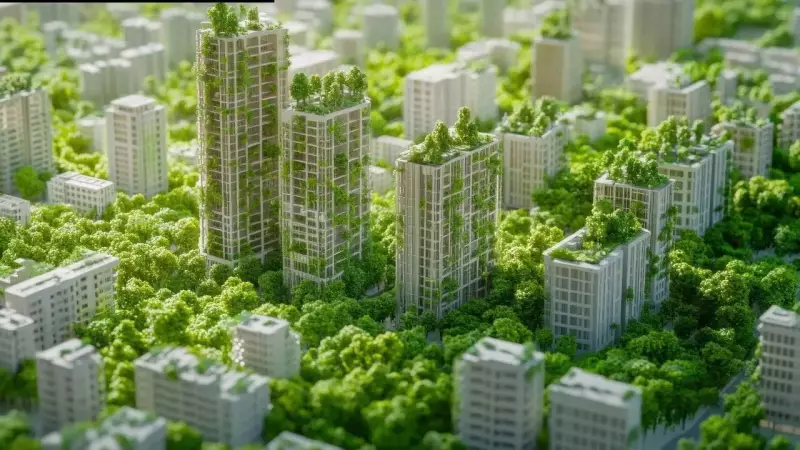
City landscapes across India face a common challenge. Decades of development have replaced green spaces with roads, concrete surfaces, parking lots, and compact housing. This transformation changes how land behaves, especially during intense heat, heavy monsoon rains, and prolonged dry spells.
The Miyawaki Approach Enters Urban Planning
Traditional tree planting often struggles in these harsh urban environments. Saplings fail to establish strong roots. They face constant stress from pollution and limited space. The Miyawaki method has entered planning conversations as a direct response to this problem.
This approach is not merely a landscaping style. It is not slow reforestation either. Instead, it represents a clever way of compressing natural forest growth into smaller urban areas. The method achieves this through careful adjustments to soil composition, plant selection, and spacing patterns.

Japanese Origins and Core Philosophy
The method carries the name of its creator, Japanese botanist Akira Miyawaki. His extensive work focused on potential natural vegetation. Miyawaki proposed a simple yet powerful idea. Every geographical region possesses a specific set of plants that would naturally dominate if human interference ceased completely.
Rather than planting just a few hardy species, Miyawaki advocated for planting many local species together. This mixture allows natural competition to shape the young forest from the earliest stages. His research initially influenced restoration projects throughout Japan. Later, the technique gained international attention and was adapted specifically for urban use where space is severely limited and soil quality is typically degraded.
Soil Preparation: The Critical Foundation
Successful implementation begins with the most demanding phase: soil preparation. Urban soil usually suffers from severe compaction. It lacks organic matter and struggles to retain water. The Miyawaki method addresses these issues directly.
Workers start by thoroughly loosening the compacted soil. They then enrich it with substantial amounts of compost and organic material. This crucial step aims to mimic the fertile conditions found in natural forest floors. However, it significantly raises both project costs and labor requirements, particularly in dense metropolitan areas.
Several projects have reported early plant losses directly linked to inadequate soil preparation rather than poor plant selection. When executed properly, the enriched soil supports dramatically faster root development. It also reduces long-term irrigation needs, creating a more self-sustaining system.
Dense Planting Drives Rapid Growth
Planting density stands as a central pillar of the method. Practitioners place saplings much closer together than in conventional tree-planting projects. Often, several plants occupy a single square meter.
This deliberate crowding forces young plants to compete intensely for sunlight from the beginning. Instead of spreading their branches outward, growth energy moves upward toward the sky. The forest canopy closes much faster. Shade develops quickly at ground level, helping retain precious soil moisture.
This high density also prevents any single species from becoming overly dominant. While the initial planting appears excessively crowded, natural thinning occurs over time. Weaker plants fail, while stronger, better-adapted specimens thrive. The result is uneven but remarkably stable and resilient growth.
Biodiversity Creates Resilient Mini-Ecosystems
Species diversity is treated as essential, not optional. Practitioners intentionally mix native trees, shrubs, and ground-covering plants together in distinct vertical layers. Each plant layer occupies a different height range and light niche within the small forest.
This multi-layered structure creates varied micro-habitats and diverse food sources. Research from urban sites shows increased insect and bird activity within mere months of planting. In some encouraging cases, observers have recorded migratory bird species visiting these young forests sooner than anticipated.
Compared to single-species plantations, these biodiverse plots demonstrate greater resilience against pest outbreaks and weather-related stress. They begin functioning as complete, miniature ecosystems relatively quickly.

Measurable Environmental Benefits
Studies indicate that dense vegetation can influence air movement at a local scale. Miyawaki forests, with their exceptional thickness, act as natural air filters. They reduce fine particulate matter like PM2.5 more effectively than isolated street trees.
Leaves trap airborne pollutants, while the vegetation itself slows wind flow. This does not solve citywide pollution challenges, but it can noticeably improve air quality around schools, residential blocks, and busy road corridors. The exact effect depends on careful placement, surrounding building structures, and local wind patterns.
Combatting the Urban Heat Island Effect
Heat reduction represents one of the strongest practical benefits associated with the method. A dense canopy provides extensive shade over surfaces that would otherwise absorb and radiate heat. Simultaneously, transpiration from countless leaves actively cools the surrounding air during daylight hours.
Temperature measurements from projects in Europe and Asia show significant differences between Miyawaki plots and adjacent paved areas. At night, the cooling effect remains more stable compared to open green spaces containing only scattered trees. This makes the approach particularly appealing for neighborhoods with extremely limited room for conventional parks.
Challenges and Considerations for Wider Adoption
Despite its clear benefits, the Miyawaki method faces obstacles to large-scale implementation. Land availability remains a major barrier in crowded cities. These forests are not designed for walking paths or recreational activities. Their dense, sometimes impenetrable structure can feel inaccessible, affecting public perception and acceptance.
Maintenance requirements are low after the forest establishes itself, but the initial two years demand consistent care and monitoring. Project costs are heavily front-loaded, primarily due to intensive soil work and the need for diverse plant materials. In colder or drier climatic zones, results can vary, and long-term performance data is still being collected and analyzed.
The method continues to attract significant attention because it grows rapidly and requires little intervention once established. Its future in our cities depends less on theoretical promise and more on practical integration into the complex fabric of everyday urban life.