

Mumbai Scorches with Highest Temperature in Five Years
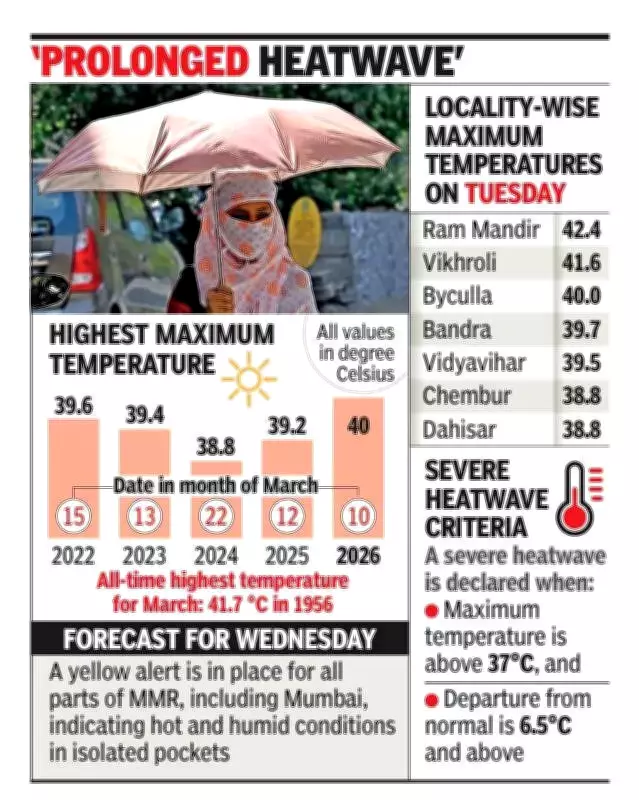
On Tuesday, Mumbai's heat intensified dramatically, with the India Meteorological Department's Santacruz observatory recording a maximum temperature of 40 degrees Celsius. This marks the highest maximum temperature the city has seen in five years, signaling a severe weather event that has gripped the region.
Severe Heatwave Conditions Declared
The recorded temperature was 7.6 degrees Celsius above normal, meeting the criteria for a severe heatwave, which is declared when the departure from normal exceeds 6.5 degrees Celsius. For context, the all-time highest temperature for March in Mumbai is 41.7 degrees Celsius, recorded on March 28, 1956, but Tuesday's reading underscores a significant climatic shift in recent times.
Widespread Heat Across North Konkan
Heatwave to severe heatwave conditions prevailed across North Konkan as temperatures soared sharply above normal levels. Dahanu also recorded 40 degrees Celsius, with a steep departure of +9.6 degrees Celsius, while Thane logged 39.2 degrees Celsius, which was 5.4 degrees Celsius above normal, indicating heatwave conditions, according to IMD officials.

IMD Alerts and Forecast
Earlier on Tuesday, the IMD issued an orange alert for Mumbai, Thane, and Palghar, indicating heatwave to severe heatwave conditions in isolated areas. For March 11, a yellow alert is in place for all parts of the Mumbai Metropolitan Region, including Mumbai, signaling hot and humid conditions in isolated pockets. From March 12 onwards, dry weather conditions are expected to resume up to March 14, providing some relief.
While the Santacruz observatory recorded 40 degrees Celsius, the IMD's Colaba observatory noted 35.4 degrees Celsius, which was 4.3 degrees Celsius above normal, highlighting variability within the city.
Expert Insights on Prolonged Heat
Abhijit Modak, an independent weather observer, explained, "Prolonged heatwave conditions are persisting due to a stagnant anticyclonic circulation over Gujarat and Rajasthan. This allows hot north to north-easterly land winds to sweep into North Konkan, replacing the usual maritime cooling with dry continental air, making the region more vulnerable to heat."
He added, "For coastal Konkan, temperatures often depend on the sea breeze versus land breeze dynamic. When the sea breeze arrives late, temperatures rise sharply, leading to heatwave conditions. Interior areas more than 10 km inland do not receive this relief, which is why the region has been under prolonged heatwave conditions since March 4."
Historical Context and Future Outlook
Rajesh Kapadia, founder of the weather blog Vagaries of the Weather, noted, "Day temperatures touching 38 degrees Celsius or slightly higher in early March are not unusual, with similar situations observed around 1981. However, what is uncommon this time is the persistence of the heat for nearly 9–10 days."
Kapadia added that conditions are expected to last until around March 13, when the anticyclone weakens. "Once an east-west trough develops over central India and breaks the anticyclone, Mumbai and the Konkan region should start getting north-westerly winds, bringing temperatures down from March 13–14 onwards."
This prolonged heatwave event raises concerns about climate impacts and urban resilience, as Mumbai faces one of its hottest periods in recent history.






