Nagpur's Environmental Crisis: NEERI Report Flags Air, Noise, and Water Pollution
The Environment Status Report (ESR) 2024-25 for Nagpur city, meticulously prepared by the National Environmental Engineering Research Institute (NEERI) on behalf of the Nagpur Municipal Corporation (NMC), has raised alarm over serious and persistent environmental challenges plaguing the urban landscape. The comprehensive assessment, which will be formally presented by NMC's public health engineering department at the general body meeting on April 22, underscores a multifaceted crisis demanding immediate attention.
Air Pollution: The Most Pressing Concern
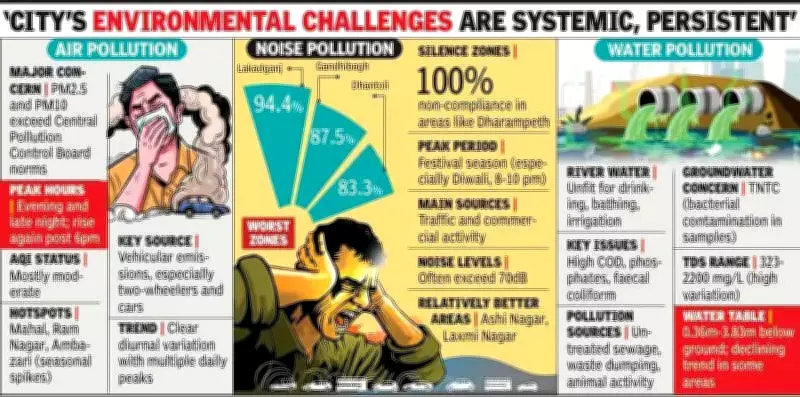
A detailed examination of the ESR reveals that air pollution remains Nagpur's most critical environmental issue. Particulate matter, specifically PM2.5 and PM10, consistently exceeds the limits set by the Central Pollution Control Board. While other pollutants generally stay within permissible ranges, the report identifies particulate pollution as the dominant citywide problem, indicating systemic failures in mitigation efforts.
Data from Continuous Ambient Air Quality Monitoring Stations (CAAQMS) illustrates a distinct daily pattern. PM levels peak during late evening and night hours, dip between 1 AM and 7 AM, rise again through the morning, fall in the afternoon, and increase once more until midnight. Nitrogen dioxide (NO2) shows a noticeable rise after 6 PM. NEERI attributes these fluctuations primarily to traffic movement patterns, with traders returning home late on two-wheelers and cars significantly contributing to emissions.

Despite these issues, Nagpur's Air Quality Index (AQI) largely remains in the "moderate" category during post-monsoon and winter seasons. However, location-specific spikes persist, highlighting spatial and seasonal variations:
- Mahal records higher AQI levels during May, June, and winter months.
- Ram Nagar peaks in April and November.
- Ambazari experiences elevated pollution levels from July to October.
Noise Pollution: Widespread Non-Compliance
Noise pollution has emerged as another major environmental concern in Nagpur. Monitoring across ten zones using the "Noise Tracker" app reveals extensive violations, particularly in designated silence zones near hospitals and schools. The data shows near-total non-compliance in areas like Dharampeth, Lakadganj, and Gandhibagh, with specific statistics highlighting the severity:
- Lakadganj recorded 94.4% non-compliance.
- Gandhibagh followed with 87.5% violations.
- Dhantoli showed 83.3% non-compliance.
Vehicular traffic and commercial activity are identified as the primary drivers of excessive noise, with some zones consistently exceeding 70 decibels throughout the day. Violations peak dramatically during festivals such as Diwali, especially between 8 PM and 10 PM, exacerbating the problem.
Water Quality: Alarming Deterioration
The report's findings on water quality are equally distressing. River water in Nagpur has been deemed unfit for drinking, bathing, and irrigation due to high chemical oxygen demand, elevated phosphate levels, and the presence of faecal coliform bacteria. This contamination is primarily attributed to untreated sewage discharge, indiscriminate waste dumping, and animal activity along riverbanks.
Groundwater quality also shows significant signs of stress. Several samples recorded bacteriological contamination, with total coliform levels marked as "Too Numerous To Count" (TNTC). Total Dissolved Solids (TDS) levels vary sharply, ranging from 323 mg/L to 2,200 mg/L, indicating localized contamination hotspots that require targeted intervention.
Furthermore, groundwater levels exhibit concerning fluctuations between 0.36 meters and 3.83 meters below ground level during pre-monsoon periods. Some areas are witnessing a steady annual decline of up to 0.40 meters, signaling potential long-term sustainability issues for water resources.

Urgent Call for Action
The NEERI-prepared ESR emphasizes that Nagpur's environmental challenges are systemic and persistent, necessitating urgent policy action, stricter enforcement of regulations, and sustainable urban planning to prevent further deterioration. The report serves as a critical wake-up call for municipal authorities, policymakers, and citizens alike to collaborate on comprehensive solutions that address air, noise, and water pollution in a holistic manner.