Nagpur's Alarming Heatwave Surge: From 7 to 30 Days Annually Over Five Decades
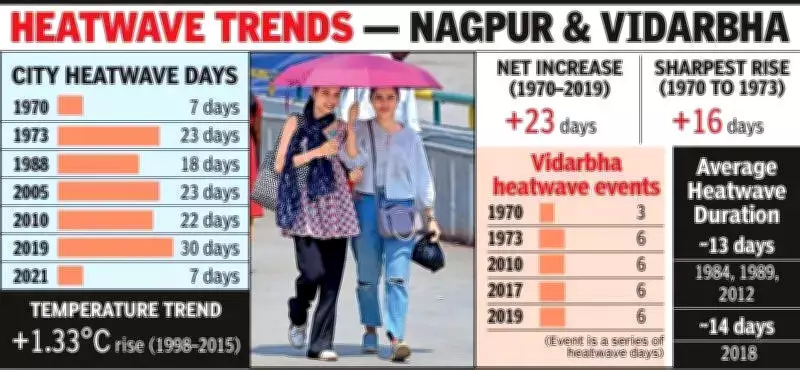
Nagpur has witnessed a dramatic escalation in heatwave frequency, with data from the India Meteorological Department (IMD) revealing a sharp increase of 23 heatwave days per year over the past five decades. The city recorded just seven heatwave days in 1970, but this number soared to 30 by 2019, highlighting a concerning trend in climate patterns.
Periodic Spikes and Peak Years in Heatwave Occurrences
The rise in heatwave days has not been gradual but marked by significant periodic spikes. After the initial count of seven days in 1970, the figure jumped dramatically to 23 by 1973—an increase of 16 days within just three years. Other notable peak years include 18 heatwave days in 1988, 23 days in 2005, and 22 days in 2010, culminating in the highest recorded level of 30 days in 2019. Interestingly, the count dropped to seven days in 2021, suggesting variability but an overall upward trajectory.
According to the IMD data, these peak years consistently coincided with periods of extensive infrastructure development and a corresponding loss of green cover in the region. This correlation points to human activities as a significant driver of the changing climate patterns.

IMD Presentation and Regional Context in Vidarbha
The data was presented by IMD forecasting officer Praveen Kumar during an interactive session titled "Heatwaves, Health Risks & Weather Reporting". This event was organized by the Regional Meteorological Centre Nagpur in collaboration with the Patrakar Club of Nagpur and Asar Social Impact Advisors, held on World Earth Day.
In the broader Vidarbha region, heatwave events have also shown repeated spikes, mirroring the trend in Nagpur. The number of events doubled from three in 1970 to six in 1973 and reached six events again in 2010, 2017, and 2019. Furthermore, the duration of heatwaves remained consistently high during peak years, with average durations hovering around 13 days in 1984, 1989, and 2012, and rising slightly to 14 days in 2018.
Health Impacts and Expert Insights on Climate Drivers
Former state surveillance officer of Maharashtra Health Services, Dr. Pradeep Awate, who also spoke at the session, emphasized that heatwaves are a direct consequence of the enhanced greenhouse effect. He explained that human-generated gases trap heat, raising temperatures beyond natural levels. Dr. Awate noted that urbanization has significantly contributed to rising temperatures in Nagpur, with studies indicating an increase of approximately 1.33°C between 1998 and 2015.
The health implications of this temperature rise are severe. Dr. Awate highlighted that heat exposure significantly affects health, with cardiovascular disease mortality increasing by about 2.1% for every 1°C rise in temperature. Overall, there is an 11.7% higher risk of health issues during heatwave periods, underscoring the urgent need for public health measures and climate adaptation strategies.