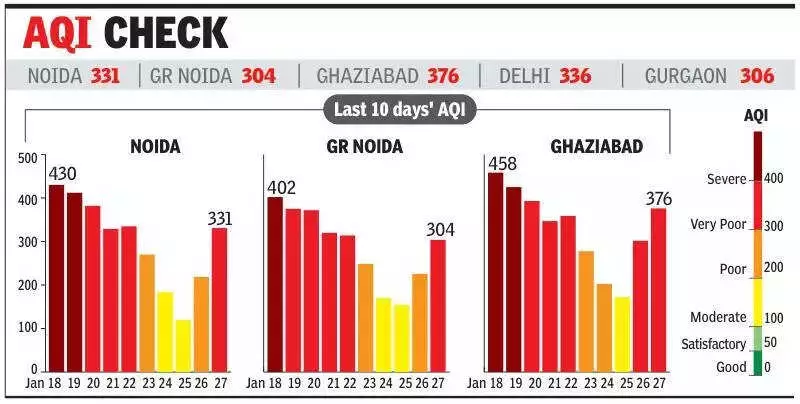
Despite experiencing daylong rainfall across the region, air quality in the National Capital Region (NCR) took a sharp turn for the worse on Tuesday, with multiple cities slipping into the 'very poor' category. This deterioration comes as a stark reversal after a brief weekend respite, highlighting the persistent nature of the pollution crisis in the area.
Sharp Deterioration in AQI Across Key Cities
In Noida, the Air Quality Index (AQI) rose dramatically to 331, categorizing it as 'very poor'. This marks a significant decline from Monday's reading of 219, which was in the 'poor' range. Similarly, Greater Noida witnessed a concerning trend, with its AQI deteriorating from 226 to 304, also entering the 'very poor' bracket.
Ghaziabad's air quality remained firmly entrenched in hazardous conditions, with the AQI climbing from 302 to 376, solidifying its 'very poor' status. This widespread decline occurred just one day after the region had briefly emerged from prolonged hazardous air conditions.

Weekend Respite Proves Short-Lived
The recent deterioration follows a temporary improvement over the weekend, when light rain on Friday helped push AQI levels into the 'moderate' range. This break ended a prolonged spell of 85 consecutive days marked by 'poor', 'very poor', and 'severe' air quality across the NCR, offering residents a brief glimpse of cleaner air.
Station-Wise Data Reveals Widespread Pollution
Detailed station-wise monitoring data from the Central Pollution Control Board (CPCB) paints a consistent picture of deterioration. In Noida, the Sector 125 air monitoring station recorded an AQI of 346, followed closely by Sector 116 at 343, Sector 1 at 333, and Sector 62 at 303—all firmly in the 'very poor' category.
Greater Noida's readings showed Knowledge Park V registering 335 ('very poor'), while Knowledge Park III stood at 273 ('poor'). Ghaziabad presented an even grimmer scenario, with the Loni station recording a 'severe' AQI of 413. Other areas in Ghaziabad, including Indirapuram (392), Vasundhara (390), and Sanjay Nagar (309), all registered in the 'very poor' range.
Delhi's Air Quality Also Worsens
The capital city mirrored this troubling trend, with Delhi's average air quality worsening to 'very poor', recording an AQI of 336. This represents a significant increase from the previous day's reading of 241 at 4 PM, when the CPCB releases its official 24-hour average readings.
Despite parts of Delhi and the NCR experiencing light rain on Tuesday, meteorological conditions and pollution sources have continued to challenge air quality improvements. However, forecasts suggest that the AQI may improve slightly to the 'poor' category on Wednesday, offering some hope for temporary relief.
This persistent air quality crisis underscores the complex interplay between weather patterns, local emissions, and regional pollution sources that continue to affect millions of residents in the NCR. The data highlights the need for sustained mitigation efforts even during periods of rainfall, which have proven insufficient to combat the entrenched pollution levels in the region.