

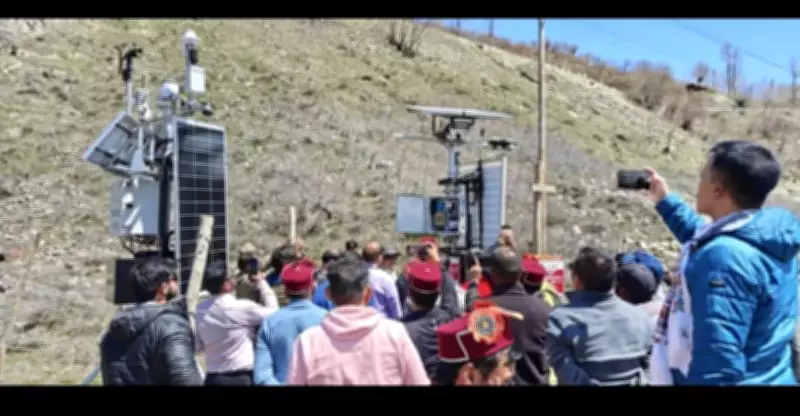
NDMA Delegation Reviews Glacial Lake Early Warning System in Himachal Pradesh
A high-level delegation from the National Disaster Management Authority has conducted a comprehensive review of a proof-of-concept glacial lake outburst flood early warning system in Himachal Pradesh, marking a significant step toward expanding monitoring capabilities across the entire Himalayan region.
Advanced Technology Demonstration at Sissu
According to NDMA secretary Manish Bhardwaj, the innovative system developed by the Centre for Development of Advanced Computing was demonstrated at Sissu on April 15. This sophisticated monitoring solution integrates multiple sensor technologies to track critical parameters including:
- Real-time weather conditions
- Visibility measurements
- Glacial lake water levels
The system transmits collected data via satellite communication, providing continuous monitoring capabilities even in remote Himalayan locations.

Multi-Agency Collaboration and Future Expansion
The review visit included officials from multiple government agencies, demonstrating a coordinated approach to disaster management. Participating organizations included:
- Central Water Commission
- Wadia Institute of Himalayan Geology
- Other relevant technical agencies
Bhardwaj announced in a LinkedIn post that "a similar system will next be installed at Gepang Gath Lake in the Lahaul and Spiti region of Himachal Pradesh after validation." This installation will serve as a crucial step toward establishing a comprehensive GLOF monitoring network across vulnerable Himalayan areas.
Technical Specifications and AI Integration
The advanced warning system developed by C-DAC incorporates multiple technological components:
- Sensor-equipped buoys for water level monitoring
- Automatic weather stations for meteorological data
- Satellite-based communication through INSAT satellites
- AI-driven geospatial analysis tools
This integrated approach enables real-time monitoring of glacial lakes while using artificial intelligence to analyze environmental changes and generate early warnings when potential threats are detected.
Growing Climate Concerns and Risk Assessment
The initiative comes amid increasing concerns about glacial lake outburst flood risks associated with climate change impacts. Rising temperatures across the Himalayan region are accelerating glacier melt, leading to:
- Formation of new glacial lakes
- Expansion of existing water bodies
- Increased risk of sudden lake breaches
These events can trigger devastating floods downstream, threatening infrastructure and communities in fragile mountain regions.
Comprehensive Risk Management Strategy
The NDMA has identified 189 high-risk glacial lakes across the Himalayas that require targeted monitoring and mitigation efforts. Several of these vulnerable lakes are located in Uttarakhand, highlighting the need for region-wide preparedness.
Officials emphasized that the satellite-based warning system represents a significant advancement in early warning capabilities for the Himalayan region. This technology will help reduce disaster risks in areas where communities and infrastructure remain highly exposed to glacial lake outburst flood hazards.
The implementation of this monitoring network demonstrates India's proactive approach to addressing climate-related challenges in vulnerable mountain ecosystems through technological innovation and inter-agency collaboration.






