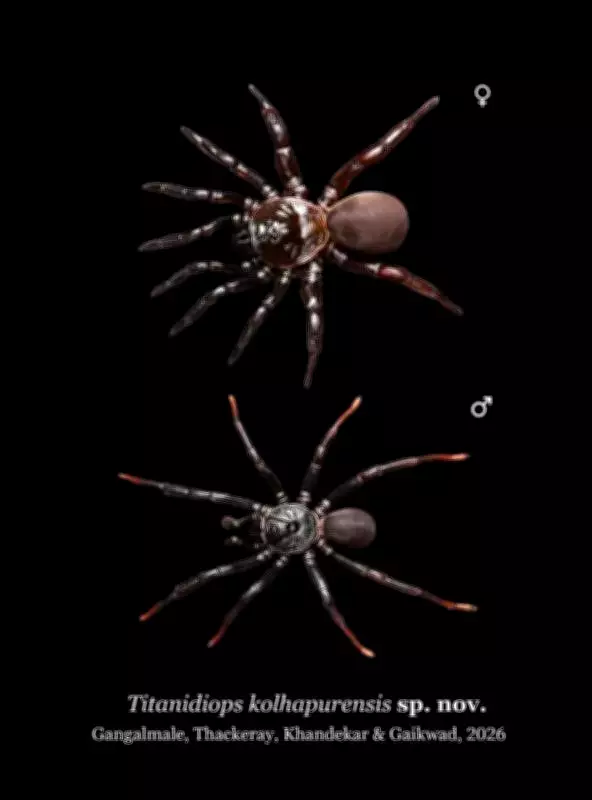
New Trapdoor Spider Species Discovered in Kolhapur Faces Imminent Extinction Threat
A groundbreaking discovery has emerged from the grasslands of Kolhapur district, where a joint research team from the Thackeray Wildlife Foundation and Shivaji University, Kolhapur (SUK) has identified a previously unknown species of trapdoor spider. The findings, published on February 4 in the prestigious UK-based Journal of Natural History, reveal a species already teetering on the brink of local extinction due to rapid environmental degradation.
Meet Titanidiops kolhapurensis: The Dark Spider of Kolhapur
The newly discovered arachnid has been formally named Titanidiops kolhapurensis, honoring its place of discovery in Kolhapur. This discovery forms the core of Satpal Gangalmale's ongoing doctoral research at Shivaji University's department of zoology, conducted under the expert guidance of entomologist Sunil Gaikwad. The research team also included prominent scientists Tejas Thackeray and Akshay Khandekar from the Thackeray Wildlife Foundation.
Satpal Gangalmale explained the spider's characteristics and nomenclature: "These spiders are commonly referred to as 'trapdoor spiders'. In Marathi, they earn the nickname 'darkari koli' due to their remarkable ability to construct hinged doors for their underground burrows. Their classification under the Titanidiops genus was determined by analyzing their specific tooth structure and the unique arrangement of their eight eyes."

Habitat Distribution and Critical Findings
The "dark spider of Kolhapur" has been documented in specific localized pockets, including the Shivaji University campus, Shenda Park, the Kolhapur Chitranagari area, and Puikhadi hill. A crucial insight from the study highlights the spider's distinct habitat preferences. Researchers observed a robust population of the species thriving in natural forests and native grasslands. However, they were completely absent in areas dominated by exotic tree plantations, particularly Gliricidia sepium, locally known as Undirmari.
Precarious Survival and Habitat Threats
Entomologist S.M. Gaikwad emphasized the fragile state of the spider's ecosystem. "This spider constructs vertical or slanted burrows in flat or sloping grassy meadows. The entrances are expertly camouflaged to blend seamlessly with the surrounding soil, rendering them almost invisible to the naked eye," he detailed. Gaikwad issued a stark warning about the species' survival, directly linking it to the preservation of these specific landscapes.
"The habitat near urban areas is undergoing rapid transformation due to construction activities, intensive agricultural practices, and the widespread planting of non-native tree species. If these human-induced environmental alterations are not urgently addressed and mitigated, this newly discovered species faces a severe and imminent risk of vanishing entirely from the region," Gaikwad cautioned.
The discovery of Titanidiops kolhapurensis underscores the rich biodiversity of Kolhapur's grasslands while simultaneously sounding an alarm about the urgent need for conservation efforts to protect this unique arachnid and its delicate habitat from irreversible destruction.