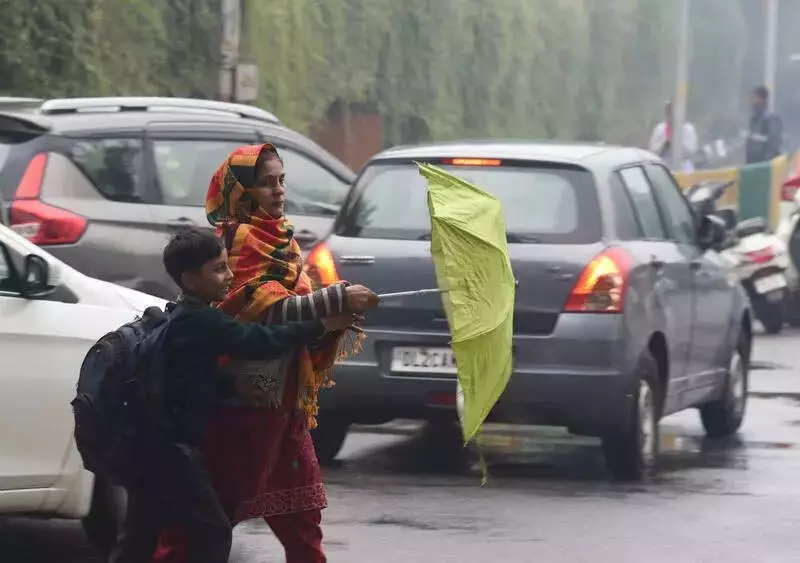
Noida Gripped by Hailstorm and Traffic Chaos as Temperatures Plummet
Noida experienced significant disruption on Tuesday as persistent drizzle and a sudden ten-minute hailstorm brought traffic to a crawl across multiple parts of the city. The adverse weather conditions severely impacted rush hour movement on major arterial roads, compounding commuting woes even as air quality showed a sharp deterioration despite the rainfall.
Sharp Temperature Drop and Visibility Issues
The rainfall intensified the winter chill, causing temperatures to fall by nearly six degrees Celsius. The maximum temperature was recorded at 16.9 degrees Celsius, a notable decline from Monday's 23.2 degrees. Morning visibility remained constrained below 500 metres, adding to the challenges for commuters. Interestingly, the minimum temperature rose to 8 degrees Celsius following the rain, compared to Monday's 4.2 degrees, which was four degrees below normal and marked the coldest Republic Day since 2021 when Delhi-NCR witnessed 2.1 degrees Celsius.
IMD Clarifies Cold Day Conditions and Weather Patterns
However, the India Meteorological Department clarified that cold day conditions were not officially met in Noida on Tuesday, as the criteria require two consecutive days of such weather. The IMD predicts a rise in mercury levels on Wednesday. A 'cold day' is defined when the minimum temperature falls below 10 degrees Celsius and the maximum temperature departure from normal is 4.5 degrees or above. On January 6, parts of the city had experienced cold day conditions.

According to IMD reports, thunderstorms accompanied by lightning and gusty winds intensified to 30-40 kmph on Tuesday afternoon. Several areas also witnessed a brief hailstorm in the evening. Ankit Kaushik, a media professional from Sector 16, recounted being caught in a hailstorm around 5 pm near Sector 18. "Rain accompanied by hail shower lasted for roughly 10 minutes. It slowed traffic in the area as bikers and people rushed to take shelter under flyovers and bus stops," he said.
Traffic Bottlenecks and Commuter Experiences
On Wednesday, skies are expected to remain cloudy with shallow to moderate morning fog, and winds may pick up to around 10 kmph by afternoon. Earlier on Tuesday, traffic near Dalit Prerna Sthal crawled during morning peak hours as commuters traveling from Greater Noida to Delhi via the Noida Expressway faced prolonged delays near the Bird Feeding Point. Congestion worsened as vehicles from Sector 18 and GIP Mall merged into the same stretch through the Film City Flyover, creating a persistent bottleneck that lasted well into the afternoon.
Arjun Kumar, a resident of Sector 30, shared his ordeal: "I was headed to Delhi but was held up for nearly 15 minutes at the Film City loop. Traffic police had narrowed the loop with barricades, and vehicles barely moved even later in the day."
Rain-induced slowdowns affected multiple locations including Sector 62, Sector 37, Pari Chowk, Gaur Chowk, and several internal stretches. Autorickshaw driver Ashish, who transports schoolchildren to Sector 50, reported taking nearly 10-15 minutes longer than usual to navigate the Vishwakarma Marg stretch between Sector 76 and 50 metro stations. "Several two-wheeler riders and pedestrians took shelter under flyovers and metro corridors, blocking traffic movement in the area," he explained.
Official Alerts and Traffic Management Efforts
The India Meteorological Department had earlier issued a yellow alert, forecasting light rainfall for the day. Officials attributed the showers and accompanying thunderstorms to western disturbances. DCP (Traffic) Manisha Singh noted that there was a significant rush in the morning as most offices and schools reopened after the long weekend and Republic Day holiday. "Vehicular movement increased significantly on Tuesday. Rainfall further reduced speeds, but traffic personnel were deployed at key junctions to ease congestion," she stated.
The combination of unseasonal weather and increased vehicular volume created a perfect storm for traffic disruptions, highlighting the city's vulnerability to sudden meteorological changes.