Noida Lags Behind NCR Peers in Pollution Grievance Redressal
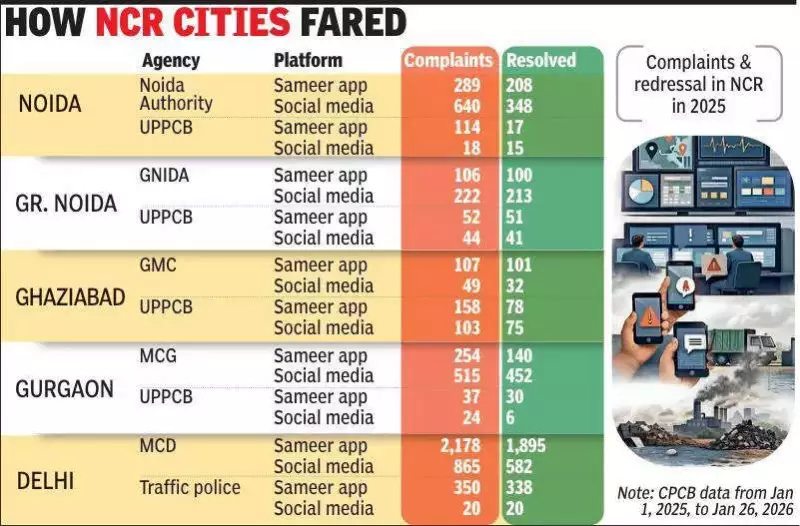
Noida has unfortunately emerged as the poorest performer among major National Capital Region cities when it comes to resolving pollution-related public complaints. According to data obtained through the Right to Information Act, the city's disposal rate has slipped below the 60% threshold, placing it at the bottom of the regional rankings.
Alarming Statistics Reveal Systemic Issues
Data shared by the Central Pollution Control Board paints a concerning picture of Noida's environmental governance. Between January 1, 2025, and January 26, 2026, the Noida Authority addressed just 556 of the 929 complaints it received through the Sameer app and social media platforms. This translates to a resolution rate of approximately 59.8%, significantly lower than neighboring municipalities.
The performance places Noida behind Greater Noida, Delhi, Ghaziabad, and Gurgaon in terms of complaint resolution efficiency. Greater Noida topped the NCR rankings with an impressive nearly 95% resolution rate for its 328 pollution complaints during the same period. Ghaziabad Municipal Corporation followed closely, settling about 85% of the 156 complaints it received.

Comparative Analysis Highlights Disparities
The Municipal Corporation of Delhi, while handling by far the largest volume of grievances, managed to resolve over four-fifths of them. Data reveals that MCD received 2,178 complaints on the Sameer app and another 865 through social media, taking the total to 3,043 complaints. Of these, 2,477 were marked resolved, representing a redressal rate of around 81%.
Gurgaon's Municipal Corporation addressed 592 of the 769 complaints lodged, leaving roughly 24% pending. Interestingly, Noida performed only slightly better than Faridabad, which resolved just 110 of the 254 complaints it received, or about 43% according to the data.
Broader NCR Complaint Tracking Framework
The CPCB systematically tracks complaints received through the Sameer app across 41 agencies in the NCR, spanning parts of Delhi, Haryana, Uttar Pradesh, and Rajasthan. Additionally, the board monitors pollution grievances posted on social media for 45 different agencies.
Over the past year, the Sameer app logged 5,370 complaints across the region, of which 3,636 (68%) were resolved. Social media platforms recorded 3,663 complaints, with 2,385 (65%) marked resolved. In both categories, MCD received the highest number of complaints, reflecting both the city's size and its residents' environmental awareness.
Nature of Pollution Complaints Filed
The grievances filed on social media and the Sameer app cover a wide spectrum of environmental concerns:
- Complaints against vehicles emitting excessive smoke
- Industrial chimneys spewing pollutants into the atmosphere
- Construction and demolition activities violating GRAP norms
- Road dust issues due to rough patches and potholes
One complainant from the Greater Noida area, Pradeep Kumar, highlighted how he had flagged road dust problems caused by deteriorating road conditions and uncovered construction work.
Questions Raised About Resolution Authenticity
Environmental activist Amit Gupta, who filed the RTI application, has raised serious questions about the high disposal rates reported by some municipalities. He claims that several complaints are being marked as resolved without any tangible action on the ground.
"It appears that many complaints are being closed without meaningful remedial work," Gupta stated, pointing to his own experience of filing a complaint in April against road construction dust near South Extension in Delhi. He revealed that the grievance was marked as resolved only in October, despite little visible improvement in the situation.
Gupta also cited ongoing underground cabling work by PVVNL along the Sector 50–51 road in Noida, where he said trenches were left uncovered, leading to persistent dust pollution despite repeated complaints from residents.

Broader Context of Environmental Governance
These concerns over complaint handling come against the backdrop of Noida's weak utilization of clean air funds. In December last year, reports revealed that the Authority had spent just 16% of the money allocated to it under the National Clean Air Programme over the previous three years.
CPCB data submitted under the RTI shows that between 2022 and 2025, Noida was allotted Rs 55.7 crore for clean air initiatives but had utilized only Rs 9 crore. This places Noida among the poorest performers nationally in terms of NCAP fund usage, suggesting systemic issues in environmental management and resource allocation.
The combination of poor complaint resolution rates and inadequate utilization of allocated funds paints a troubling picture of environmental governance in Noida. As pollution continues to be a major concern for NCR residents, these findings highlight the need for more effective implementation of environmental protection measures and greater accountability in addressing public grievances.