

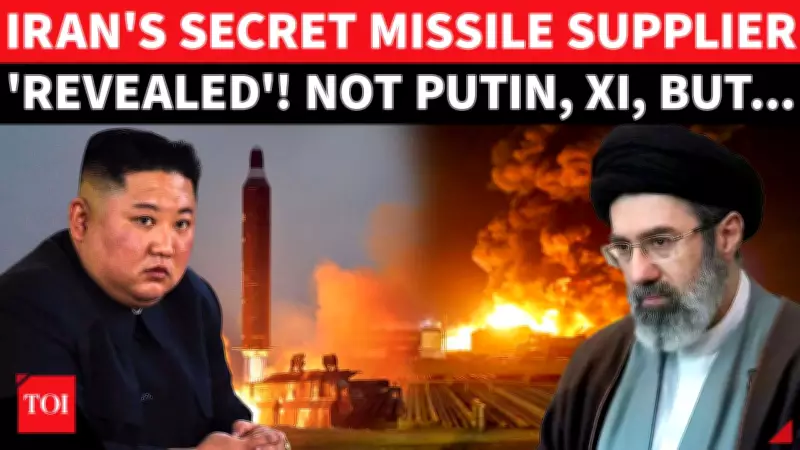
North Korea's Covert Missile Technology Transfer to Iran Revealed
As the West Asia conflict enters its fifth week of intense escalation, a startling revelation has emerged from security analysts, pointing to a clandestine military partnership that could significantly alter the geopolitical landscape. According to leading security expert and professor Bruce Bechtol, some of the advanced missile systems deployed by Iran against U.S. and Israeli targets are not entirely indigenous but are either direct North Korean imports or heavily based on North Korean designs and technology.
Expert Analysis Points to Pyongyang's Hidden Hand
Bruce Bechtol, a respected authority on Northeast Asian security and a former intelligence officer, has provided detailed analysis suggesting that North Korea has been quietly supplying missile technology to Iran. This covert support enables Tehran to enhance its strike capabilities beyond what was previously assessed by Western intelligence agencies. The revelation comes amid a series of high-profile missile attacks where Iranian forces have demonstrated improved accuracy and range, characteristics that align with known North Korean ballistic missile programs.
The implications of this partnership are profound, as it represents a strategic alignment between two nations that are both under stringent international sanctions and have historically been adversaries of the United States. Unlike more public alliances with China or Russia, this North Korea-Iran axis operates in the shadows, focusing on specific military-technical cooperation that directly impacts the battlefield dynamics in West Asia.

Escalating Conflict and Technological Warfare
The war has seen a dramatic increase in the use of sophisticated missile systems over the past five weeks. Iranian forces have reportedly targeted multiple U.S. military installations and Israeli defense positions with a variety of missiles, some of which exhibit design features and performance metrics consistent with North Korea's KN-series and Hwasong missiles. These systems are known for their mobility, solid-fuel propulsion, and potential to evade certain missile defense systems.
This technological transfer is not merely about hardware; it likely includes critical knowledge sharing on missile guidance, warhead design, and launch protocols. Such collaboration allows Iran to rapidly upgrade its arsenal without the lengthy development cycles typically associated with advanced missile programs. For North Korea, the partnership provides valuable field-testing data and potential financial benefits, despite international sanctions aimed at curtailing its weapons exports.
Broader Geopolitical Ramifications
The emergence of this covert alliance adds a new layer of complexity to the already volatile West Asia conflict. It suggests a more interconnected network of U.S. adversaries than previously acknowledged, with Pyongyang playing a direct, albeit hidden, role in regional hostilities. This development could prompt a reassessment of U.S. and allied strategies, as countering Iranian missile threats now implicitly involves addressing North Korean technological contributions.
Furthermore, this revelation raises urgent questions about the effectiveness of global non-proliferation efforts and sanctions regimes. If North Korea can successfully transfer missile technology to Iran amidst intense international scrutiny, it indicates significant gaps in monitoring and enforcement mechanisms. The situation underscores the challenges of preventing the spread of advanced weaponry in a multipolar world where clandestine partnerships can flourish.
As the conflict continues to escalate, with recent reports of attacks on U.S. aircraft and heightened tensions in the Red Sea, the role of external actors like North Korea becomes increasingly critical. Understanding the full extent of this missile technology transfer will be essential for formulating effective diplomatic and military responses to de-escalate the situation and prevent further proliferation of advanced weapons in conflict zones.






