

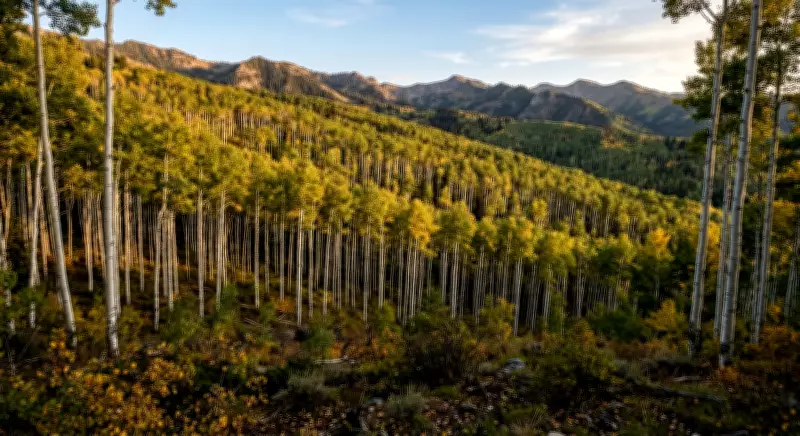
Pando: A Forest of One
In central Utah, within Fishlake National Forest, lies a remarkable natural wonder that defies conventional understanding. What appears to be a forest of thousands of white-bark aspens shimmering across a hillside is, in reality, a single living organism. Each trunk, branch, and leaf belongs to one interconnected root system, making Pando a singular entity.
One Root, 40,000 Trees
Pando is a clonal colony, a tree-like organism that has sprouted over 40,000 stems from a single sprawling root system. Although these stems resemble individual trees, they are all genetically identical and connected underground. The name Pando, Latin for "I spread," aptly describes its expansive nature. Covering 106 acres and weighing approximately 13 million pounds, Pando ranks among the largest and heaviest living beings ever documented. Scientists estimate its roots took hold at the end of the last Ice Age, meaning this organism has silently endured millennia of climate change, wildfires, and shifting landscapes. Many visitors might pass through, seeing only a pretty grove of aspens, unaware of the extraordinary unity beneath the surface.
Why a ‘Forest of One’ Changes Your View of Nature
The Utah Historical Society describes Pando as a "forest of one," a phrase that captures its paradoxical nature. A forest implies many, while one suggests a single entity; Pando embodies both simultaneously. While clonal growth occurs in other plants like strawberries and grasses, Pando operates on a scale that challenges our perception of individuality. It demonstrates that an organism can persist through deep time not by constant upward growth, but by renewing itself from its roots, sending up new stems while the ancient network endures below.

The Bit Nobody Wants to Talk About
Despite its grandeur, Pando is in trouble. A study published in Conservation Science and Practice reveals that the grove's regeneration is compromised by overabundant deer and elk that graze on young shoots. The dominant ecological concern is an inverse relationship between recruitment success and browse pressure: animals eat the young stems before they can mature, and old stems die without replacement. The study also found that without consistent protection from herbivores, the clone is fragmenting into ecologically distinct pieces, depending on which areas are fenced off. This organism, which has thrived together for thousands of years, is now falling apart. This is not a theoretical issue; it is happening now, and decisions about fencing, grazing management, and land use in Fishlake National Forest will determine Pando's survival.
What Pando Asks of Us
Pando embodies a collision of scale, age, and ecological vulnerability. It is ancient enough to be legendary, vast enough to redefine what a single organism can be, and fragile enough to remind us that longevity is not eternity. For a US audience accustomed to thinking national parks and forests are protected by default, Pando serves as a corrective: protection requires active work, ongoing management, political will, and public interest. A grove that survived the Ice Age can still be lost on our watch if we are not paying attention. The most quietly radical aspect of Pando is not its size, but how it collapses the distance between a forest and a single life. Once you understand that, you can never look at a stand of aspens the same way. That shift in perspective—from many to one—is the beginning of caring about what happens next.






