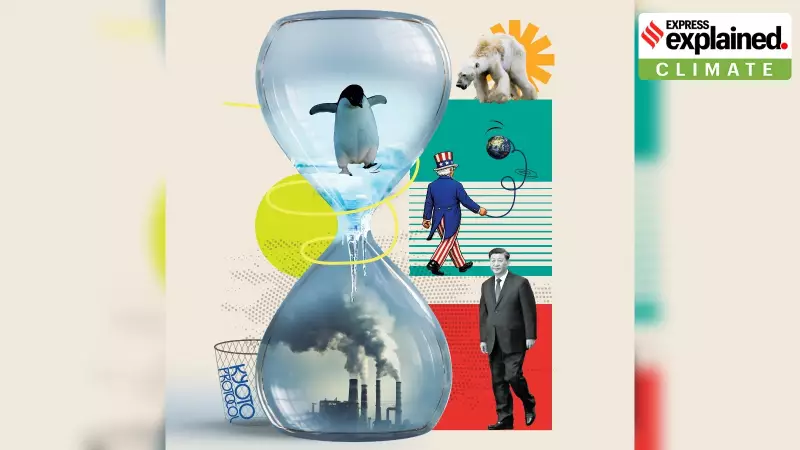
November 2025 marked a significant milestone and a moment of intense reflection for the global climate community. The Paris Agreement, the landmark international treaty designed to orchestrate the world's response to climate change, completed ten years. This anniversary, however, was not merely a celebration but a catalyst for a profound reassessment of the pact's core principles, its effectiveness, and its very future.
The Unraveling Consensus and a New Power Dynamic
The sense of disillusionment did not emerge overnight, but the US withdrawal from the Paris Agreement in early 2025 acted as a major accelerant. More crucially, developing nations began to voice long-held frustrations. They argued that while the treaty imposed clear obligations on them—such as mandatory climate actions and greenhouse gas (GHG) inventory submissions—it had failed to deliver the promised financial and technological resources. Furthermore, they felt the agreement unfairly constrained their energy, economic, and industrial policy choices.
This discontent culminated in a visible shift in power dynamics at the COP30 climate conference in Belém, Brazil. Led by influential economies like China, India, Saudi Arabia, and Brazil, developing countries successfully pushed two of their long-standing demands into the final outcome. They also blocked language on a fossil fuel phase-out championed by the European Union. This demonstrated that in the absence of the US, large developing nations could steer the conversation. China, in particular, emerged as a decisive actor, poised to fill the leadership vacuum.

Questioning the Core: Mitigation vs. Development Realities
Beyond geopolitical shifts, countries have begun to question the fundamental assumptions of the Paris architecture. The treaty's mitigation-centric approach, focused on limiting global temperature rise to 1.5°C or 2°C above pre-industrial levels, is being critically examined. The premise of universal, best-effort global cooperation has shown shaky foundations, disconnected from the realities of international relations and national priorities.
This design flaw, many argue, stems from the transition from the 1997 Kyoto Protocol. Kyoto operationalized the principle of "common but differentiated responsibilities and respective capabilities" (CBDR-RC), placing legally binding emission cuts on a defined group of historically responsible developed nations. The Paris Agreement, in contrast, made climate action a voluntary contributory task for all. The last decade has revealed a stark truth: when a responsibility is everyone's, it often becomes no one's. The world remains far off track from meeting its 2030 emission reduction milestones.
The Indian Voice and the Call for Alternative Pathways
India was the first to formally articulate the demand for a course correction. In 2024, it argued that an obsessive focus on temperature targets was a flawed strategy. India contended that a 2°C warmer world would not be apocalyptic and that economic development and prosperity are the best forms of climate adaptation, building societal resilience. It championed giving adaptation equal priority to mitigation, especially for developing nations.
India's stance is rooted in its unique challenges: it is home to one-sixth of humanity with low per capita income. Lifting its population out of poverty necessitates energy use and, consequently, increased emissions in the short term. Mechanisms like the EU's Carbon Border Adjustment Mechanism (CBAM), which penalizes carbon-intensive imports, are seen as punitive and morally wrong when applied equally to nations at vastly different development stages. This perspective found an unexpected ally in Microsoft co-founder Bill Gates, who emphasized that investments in health, sanitation, poverty reduction, and early warning systems could yield better climate resilience outcomes.

The China Model: A Blueprint for Sovereign Action?
The emerging consensus among developing countries is the need for sovereign, alternative pathways tailored to national circumstances and capabilities. Many look to China's trajectory as a potential model. Classified as a developing nation, China was not required to make direct emission cuts for decades. In that time, it became the world's largest emitter but also built the planet's largest renewable energy capacity. Now, having announced plans to peak and reduce emissions by 7-10%, China may be positioned to decarbonize faster than any developed nation, potentially achieving net-zero before its 2060 target.
China's story suggests it is possible to pursue development and later accelerate climate action on one's own terms—a pathway different from the Paris prescription. While not every nation has China's scale, India is seen as the closest analogue. The core argument is for the freedom to find nationally suitable solutions. The Paris Agreement's first decade unleashed thousands of climate actions worldwide, but its second decade may be defined by a more fragmented, pragmatic, and sovereignty-driven search for effective responses to the climate crisis.