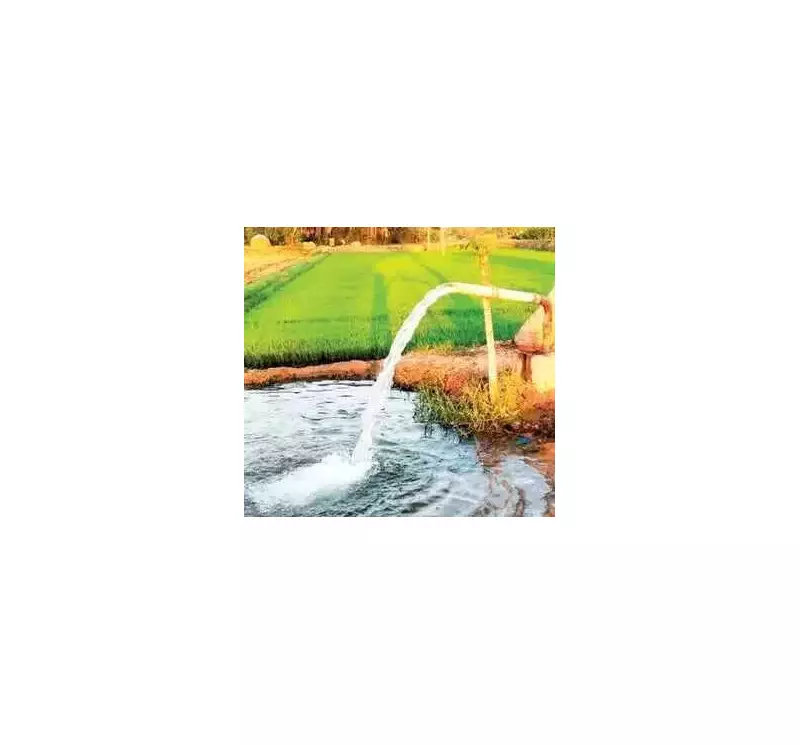
A recent national report has revealed a severe and worsening groundwater crisis in North India, with Punjab, Rajasthan, and Haryana extracting far more water than is naturally replenished each year. The Central Ground Water Board's (CGWB) 2025 National Compilation on Dynamic Ground Water Resources of India shows these three states are the only ones in the country where extraction rates have crossed the critical 100% threshold.
Alarming Numbers: Punjab Tops the Over-Exploitation Chart
Punjab's groundwater extraction was recorded at a staggering 156.36% for the last year. This means for every 100 units of water replenished, 156 units were pumped out. Rajasthan followed closely at 147.11%, and Haryana at 136.75%. This is in stark contrast to the national average extraction rate, which stands at 60.63%.
The stage of groundwater extraction is a key indicator. Extraction over 100% is classified as 'over-exploited,' 90%–100% is 'critical,' 70%–90% is 'semi-critical,' and up to 70% is considered 'safe.' While there was a minor national decrease in annual groundwater extraction from 27.66 billion cubic metres (BCM) in 2023 to 26.27 BCM in 2024, the situation in the northern states remains dire.

The Root Cause: Over-Reliance on Paddy Irrigation
The report pinpoints the primary driver of this crisis: agriculture, specifically paddy cultivation. A massive 94.74% of the extracted groundwater, or 24.89 BCM, is used for irrigation. Industrial use accounts for only 0.25 BCM, and domestic use for 1.12 BCM. This heavy dependence is facilitated by over 1.45 million agricultural pump sets across Punjab.
Experts note that there has been no significant shift away from water-intensive paddy, even as aquifers deplete. The problem is exacerbated by a drastic reduction in the area under less water-demanding crops like cotton. From nearly 600,000 hectares until 2012-13, cotton sowing in Punjab has shrunk to about 100,000 hectares in 2024-25, partly due to successive pest attacks eroding farmer confidence.
Geographical Spread and Local Variations
The over-exploitation is widespread. In Punjab, out of 153 assessment units, 111 units (72.55%) are categorised as over-exploited. Ten blocks are critical, 15 are semi-critical, and only 17 blocks are safe. Geographically, 68.35% of the state's recharge-worthy area is over-exploited.
However, the data shows some local variation. Muktsar district is 100% safe, with all four blocks in the safe category. Pathankot is 66.67% safe, and Fazilka is 60% safe. In contrast, ten districts in the state are found to be 100% over-exploited.
The disparity with the national picture is stark. While only 10.80% of blocks across India are over-exploited, Punjab has 72.55% of its blocks in this category. Rajasthan and Haryana are not far behind, with 70.53% and 63.64% over-exploited blocks, respectively.
Calls for Action and Conservation Initiatives
Alarmed by the fast-depleting resource, farm scientists and alumni of Punjab Agricultural University (PAU) formed the Punjab Water Conservation Initiative Group in 2024. The group aims to tackle the crisis through awareness, policy engagement, advocacy, and promoting crop diversification.
"We are alarmed at the groundwater situation in Punjab and have decided to engage in creating awareness, policy engagement, advocacy, and crop diversification to improve the efficiency of water use by domestic, agricultural, and industrial users," said Kahan Singh Pannu of the group. Their efforts highlight the urgent need for corrective measures to secure Punjab's water future.
The CGWB report serves as a critical warning. Without a significant shift in agricultural patterns and water management policies, the breadbasket of India faces a severe threat to its long-term sustainability and farmer livelihoods.