

Rajasthan's Failure to Protect Deemed Forests Sparks Environmental Concerns
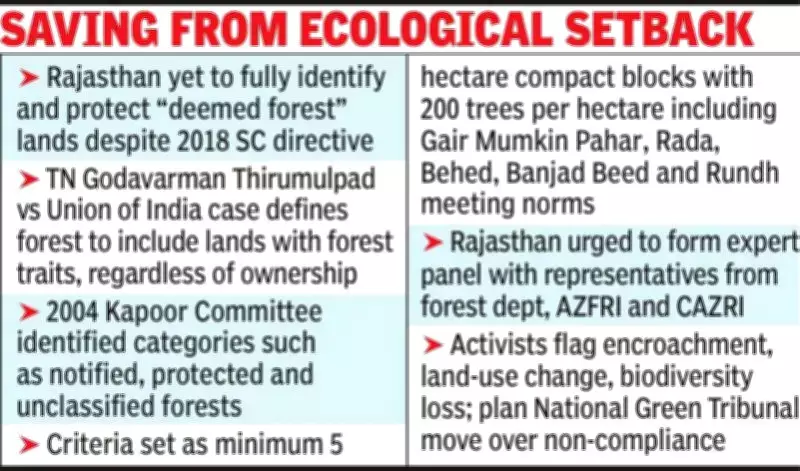
Six years after the Supreme Court's landmark 2018 directive requiring states to identify and protect "deemed forest" lands, Rajasthan remains in non-compliance, leaving numerous ecologically sensitive areas vulnerable to degradation and illegal encroachment. This ongoing failure persists despite clear judicial mandates and multiple expert committee recommendations spanning nearly two decades.
Legal Framework and Historical Context
The legal foundation stems from the pivotal case TN Godavarman Thirumulpad v. Union of India & Ors., which established that the definition of "forest" under the Forest Conservation Act of 1980 extends beyond officially notified forests. The ruling specifically includes areas recorded as forests in government records and lands possessing forest characteristics—collectively termed "deemed forests"—regardless of ownership status.
Recent Violations Highlight Systemic Failures
A recent investigation has revealed alarming violations, with reports indicating that approximately 150 bigha of deemed forest land in Padasoli village, located within Bassi tehsil of Jaipur district, was allegedly sold through an official registry. This transaction directly contravenes Supreme Court orders and involves land classified under traditional categories of "Beed" and "Banjar Beed," which are recognized as having forest characteristics.

Decades of Delayed Implementation
The state's delay is particularly striking given the historical context. Initial recommendations came from the Kapoor Committee in 2004, followed by subsequent reviews conducted by the Central Empowered Committee. Both bodies were tasked with creating comprehensive mapping systems and establishing legal recognition protocols for forest lands throughout Rajasthan.
The Kapoor Committee established clear identification criteria, including:
- Notified forests, protected forests, and unclassified forests
- Sacred groves such as Orans and Dev-Vans
- Rundh lands and other areas demonstrating forest characteristics
The committee defined deemed forests as compact blocks covering five hectares or more with a minimum density of 200 trees per hectare. Specific exclusions were made for plantations on non-forest lands and small fragmented groves deemed difficult to manage, with the notable exception of Rundh in Alwar district, which received designation as Reserved Forest.
Expert Recommendations Ignored
The committee further urged the formation of an expert panel comprising representatives from the forest department, the Arid Zone Forestry Research Institute, and the Central Arid Zone Research Institute. This multidisciplinary team was intended to finalize identification processes for unique arid and desert ecosystems, including grasslands, rocky outcrops, and stony deserts—critical habitats that remain inadequately protected.
Official Response and Environmental Concerns
A senior forest official, speaking on condition of anonymity, stated, "We are currently compiling district-wise data, and Orans in the state are mostly secured. Many of these lands include private holdings, so careful examination is essential before initiating litigation. We are committed to completing this exercise."
Environmental advocates have expressed profound concern over the continued delays. Green activist Rajendra Tiwari warned, "We will escalate this matter to the National Green Tribunal soon, as the delay represents a serious ecological threat. The land use of these deemed forests is being altered on a large scale, and the Supreme Court's directives are being systematically ignored."
Experts emphasize that prolonged inaction weakens legal safeguards against deforestation and accelerates biodiversity loss, potentially causing irreversible damage to Rajasthan's fragile ecosystems. The state's failure to implement these protective measures raises significant questions about environmental governance and compliance with judicial mandates.






