

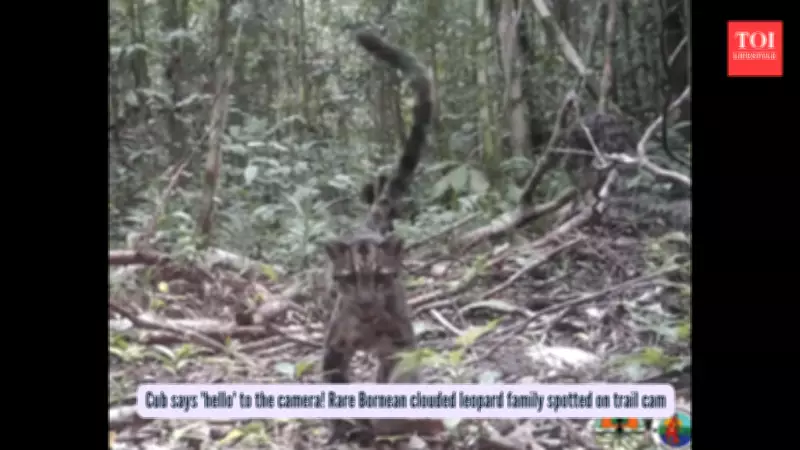
Trail Camera Reveals Rare Clouded Leopard Family in Borneo's Rainforest
Imagine wandering through a steamy, dense rainforest, your heart pounding as you catch a glimpse of something truly wild and exceptionally rare. Many of us dream of those iconic National Geographic moments, whether it's locking eyes with a tiger or witnessing an eagle's dramatic dive. However, the real magic of nature often unfolds quietly, far from human crowds and interference.
The Silent Observers: How Trail Cameras Capture Nature's Secrets
When motion-sensor trail cameras, those discreet and innovative gadgets, snap photos in the shadowy undergrowth, they capture scenes that human eyes frequently miss. These devices reveal the secret, intimate lives of elusive animals that remain largely unknown to science, such as shy feline predators prowling through ancient, towering trees.
In remote locations like the jungles of Borneo, where trees reach incredible heights and mist perpetually hangs low, these cameras are far more than mere technological toys. They serve as critical lifelines for dedicated scientists and conservationists battling to save species teetering on the brink of extinction.

Historic Footage: A Mother Leopard and Her Cubs
Recently, one such trail camera has achieved a remarkable breakthrough by capturing images of a rare and vulnerable predator species from the leopard family. Deep within Tanjung Puting National Park, a motion-sensor camera recorded footage that surpassed all expectations: a mother Bornean clouded leopard guiding two tiny, curious cubs through thick, verdant bushes. In a particularly heartwarming moment, one cub paused to stare directly into the camera lens before playfully scampering away to follow its mother.
According to an official report from the Orangutan Foundation and park authorities, this sighting marks the very first time they have documented a mother clouded leopard with offspring in this protected area. Previously, only solitary adult individuals had been recorded by the cameras. The Bornean clouded leopard ranks among Southeast Asia's rarest and most elusive wild cats, typically remaining hidden within dense, inaccessible forest habitats.
This groundbreaking observation provides concrete proof that the national park actively supports successful breeding populations, not merely transient wanderers.Expert Insights on the Clouded Leopard's Ecological Role
“The clouded leopard is an arboreal species and an excellent hunter on the ground that plays a vital role in maintaining the delicate ecosystem balance,” explained A. Yoga Perdana, research manager for the Orangutan Foundation. “As one of the rarest species to encounter, being able to observe a female with her cubs offers us compelling evidence that these animals are healthy and actively breeding within this habitat.”
Adaptations of an Elusive Jungle Hunter
Perfectly adapted for life in Borneo's dense canopy, these remarkable cats possess unique physical traits that enable their survival. They can climb headfirst down tree trunks thanks to their enormous paws, sharp retractable claws, and a long tail that provides exceptional balance. Their diet includes monkeys, deer, wild pigs, and various birds, aided by the longest canine teeth relative to body size of any cat species, measuring up to two inches in length.
Bornean clouded leopards are distinguished from their mainland relatives by their darker gray fur and distinctive, spotty cloud-like markings, which offer superior camouflage in their shadowy forest environment.
Conservation Challenges and Hope for the Future
Why is the clouded leopard classified as a vulnerable species? Rampant habitat destruction, primarily driven by deforestation for palm oil plantations, has devastated much of their natural territory. Current estimates suggest that perhaps only 5,000 to 11,000 Bornean clouded leopards remain in the wild, highlighting the urgent need for effective conservation strategies.
Camera traps provide a non-intrusive, highly effective method to monitor these elusive creatures without disturbing their natural behaviors. Beyond delivering heartwarming and captivating footage, this recent discovery demonstrates that well-protected forest reserves can indeed sustain new generations of wildlife.






