Rohingya Refugees Confront Severe Food Assistance Reductions in Overcrowded Bangladesh Camps
Hundreds of thousands of Rohingya refugees struggling for survival in Bangladesh's severely overcrowded camps are bracing for a significant reduction in their food assistance starting this Wednesday. This development has triggered widespread alarm throughout an already desperate community that faces extreme hardship daily.
Current Aid Levels and Historical Context
Currently, approximately 1.2 million Rohingya refugees confined to squalid camp conditions receive $12 per person each month. This persecuted minority from Myanmar has consistently warned that this amount is barely sufficient for basic sustenance. The majority of these refugees fled brutal military attacks in Myanmar during 2017 and remain legally prohibited from working in Bangladesh, leaving them almost entirely dependent on international humanitarian aid for survival.
New Tiered Assistance System Implementation
Under the United Nations World Food Program's newly implemented tiered assistance framework, the amount each individual receives will now vary according to their family's assessed needs. Approximately 17% of the camp population will receive as little as $7 monthly, while about one-third classified as extremely food insecure—including households headed by children—will continue receiving the previous $12 allocation.

It is very difficult to understand how we will survive now with only $7. Our children will suffer the most, expressed Mohammed Rahim, a camp resident who reported that he and his wife were already struggling to feed their three children before this reduction. I am deeply concerned that people may face severe hunger and some may even die due to lack of food.
Funding Challenges and Official Explanations
The WFP has repeatedly cautioned that camp rations faced potential reductions following steep foreign aid cuts by the United States and other nations last year, which resulted in the agency losing approximately one-third of its funding. However, WFP spokesperson Kun Li clarified that Wednesday's food distribution changes were unrelated to these funding reductions and should not be characterized as a ration cut, despite two-thirds of refugees receiving reduced assistance.
The agency emphasized that a true ration cut would imply food assistance falling below the recommended minimum standard of 2,100 calories daily for emergency aid. They maintained that even those receiving just $7 monthly would still meet this nutritional threshold.
This plan ensures that even with differentiated ration sizes, all Rohingya continue meeting their minimum food needs, strengthening fairness, transparency, and equity in food assistance, the WFP stated officially.
Local Authorities Express Grave Concerns
Bangladesh's Refugee Relief and Repatriation Commissioner Mohammad Mizanur Rahman countered that this change effectively constitutes a ration cut for the Rohingya community. With desperation already at critical levels, Rahman warned that refugees would likely attempt to flee in search of food and employment opportunities.
Law and order will be deteriorated, he cautioned in comments to The Associated Press.
Broader Political and Humanitarian Context
The same Myanmar military that attacked the Rohingya in 2017—actions the United States declared genocide—overthrew Myanmar's government in 2021 and maintains control, making safe return virtually impossible for refugees. Last year's foreign aid reductions exacerbated misery throughout the camps, particularly affecting children through school closures that contributed to increased kidnapping, child marriage, and child labor incidents.
Rohingya support programs were only approximately half-funded in 2025 and are merely 19 percent funded this year, creating severe operational constraints.
Historical Precedents and Current Protests
In 2023, the WFP reduced rations to $8 monthly due to donation declines. By November that year, the agency reported that 90% of camp residents couldn't afford adequate diets and 15% of children suffered acute malnutrition—the highest rate ever recorded in these camps. Rations were restored to $12 monthly in 2024.

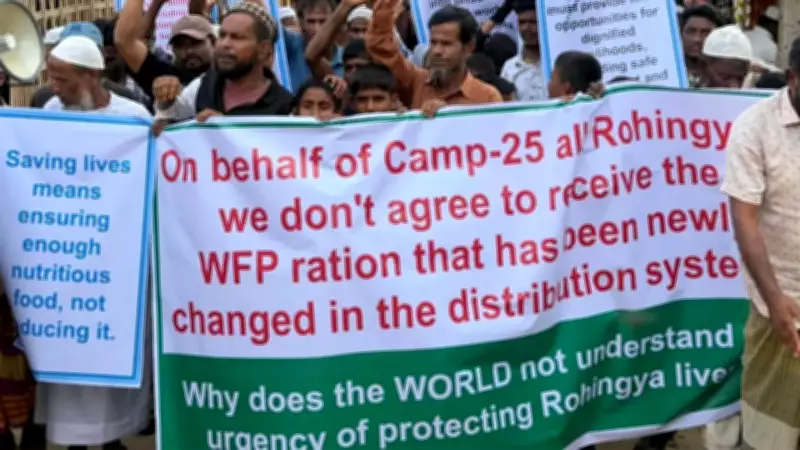
Hungry, exhausted, and increasingly hopeless refugees who endured previous ration cuts now fear how they will cope moving forward. Dozens of Rohingya staged protests against the new system on Tuesday, demanding full ration restoration while holding signs declaring Food is a right, not a choice and warning of impending starvation.
Personal Accounts and Desperate Alternatives
Mohammed Rahim, whose food aid has been reduced to $7 monthly, reported being ill while his children face kidnapping, violence, and trafficking risks if they attempt to leave camps for income opportunities. He revealed that several acquaintances are considering returning to Myanmar despite severe dangers, while others contemplate fleeing to Malaysia via perilous fishing boat journeys that claim hundreds of Rohingya lives annually.
Ration cuts are pushing people toward life-threatening risks, leaving them with no safe choices, Rahim concluded. I am very worried about the future of our children.