

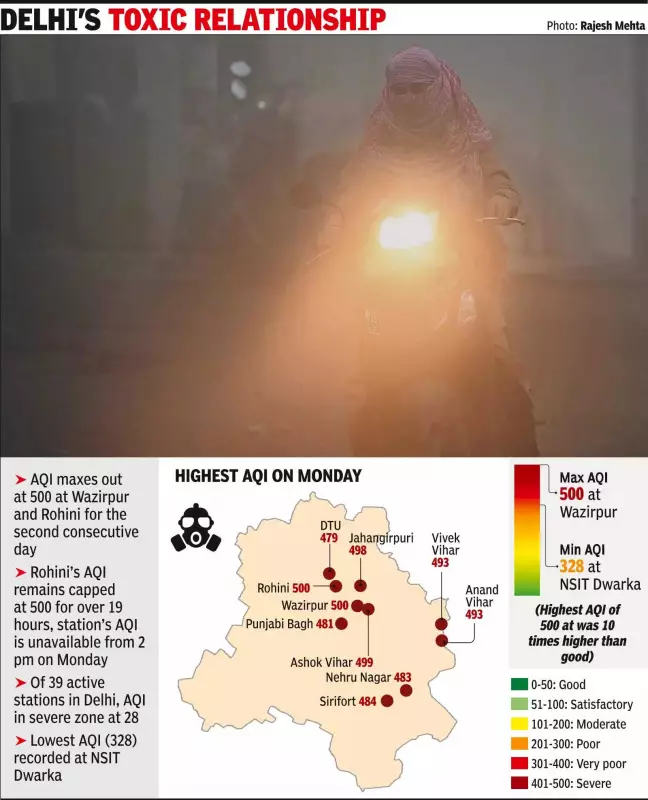
New Delhi grappled with another day of hazardous air, with the Rohini area experiencing a severe air quality index (AQI) that maxed out at the scale's limit for an extended period, only for the data to later become unavailable, raising questions.
AQI Hits Ceiling, Then Disappears
The air quality monitoring station in Rohini recorded an AQI of 500, the maximum measurable value on the scale, for a staggering duration of over 19 hours. This severe pollution level persisted from 6 pm on Sunday until 1 pm on Monday. However, from 2 pm onwards on Monday, the AQI for Rohini was listed as unavailable on the official boards, with "insufficient data" cited as the reason.
This absence of data occurred despite the Delhi Pollution Control Committee's (DPCC) figures showing that readings for all major pollutants, except for PM2.5, were available. Officials from both the DPCC and the Central Pollution Control Board (CPCB) did not respond to media queries regarding the missing AQI information for Rohini.

Experts Question Data Gaps, Point to Local Emissions
Air quality analysts have scrutinized the data gap. Sunil Dahiya, founder and lead analyst at the think tank EnviroCatalyst, pointed out that CPCB's own data indicated PM10 levels for Rohini were missing for only two hours at night. The available hourly PM10 concentration was alarmingly high, peaking at 907 micrograms per cubic metre at 3 am and dropping to a still-severe 318 micrograms per cubic metre at 7 am.
"Since only one particulate matter reading is technically needed for AQI calculation, enough data was available to compute Rohini's AQI," Dahiya stated. He emphasized that since the AQI was already at its cap of 500, the actual intensity of pollution could have been even higher. He added that the hazardous air was not uniform, with some stations showing worse levels, indicating the presence of high local emission sources around those areas.
Dipankar Saha, former head of CPCB's air laboratory, clarified India's AQI calculation protocol, stating, "A minimum of two major or dominant parameters, one of which must be particulate matter, are required for the final calculation of AQI."
Widespread Severe Air Grips the Capital
The crisis was not confined to Rohini. Wazirpur witnessed its AQI reach the maximum 500 mark for the second consecutive day, remaining at that extreme level for 17 hours from Sunday afternoon before slightly dropping to 499 at 9 am on Monday.
The grim, grey haze enveloped most of the city. Out of 39 active air quality monitoring stations in Delhi, 28 registered AQI in the severe range. Numerous locations recorded levels close to the extreme for two days in a row. Among the worst-affected areas were:
- Ashok Vihar (499)
- Jahangirpuri (498)
- Anand Vihar (493)
- Vivek Vihar (493)
- Siri Fort (484)
- Nehru Nagar (483)
- Punjabi Bagh (481)
- Delhi Technical University (479)
Despite sunshine in parts of the city, there was no respite from the toxic air in many pockets, driven by a high load of emissions from local sources. The episode underscores the persistent and severe nature of Delhi's winter air pollution crisis, compounded by challenges in consistent data reporting.






