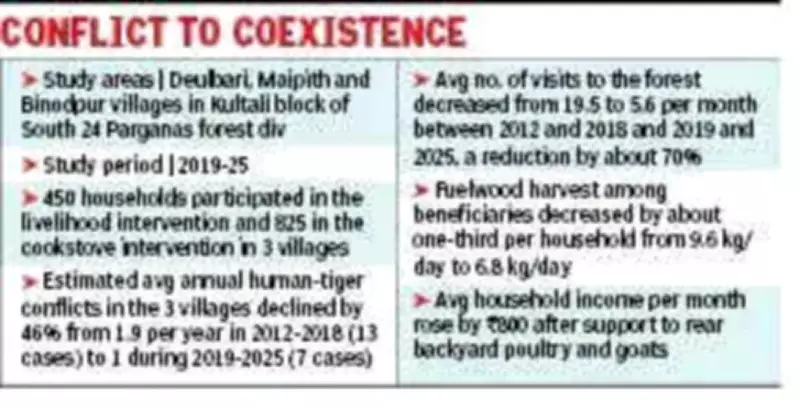
A recent study released ahead of World Environment Day on June 5 has revealed that safer livelihood practices have significantly reduced human-tiger conflicts in three fringe forest villages in the Sundarbans. The villages—Deulbari, Maipith, and Binodpur—located in the Kultali block, one of the most conflict-prone zones in the region, saw a 46% decline in such conflicts over seven years.
Key Findings of the Study
The study, conducted by researchers from TERI School of Advanced Studies (TERISAS), Wildlife Trust of India (WTI), and Lokmata Rani Rashmoni Mission (LRRM), found that forest visits for fuelwood harvesting dropped by 70%, and average household income increased by Rs 800 per month after households were supported to rear backyard poultry and goats as safer livelihood options.
Impact on Forest Dependency
According to Abhishek Ghoshal, human-wildlife conflict mitigation head at WTI, all three study villages are within one kilometer of the forest boundary, where main livelihood activities include fishing, honey collection, crab harvesting, fuelwood collection, and prawn seed collection. The study analyzed the impacts of safer and energy-efficient livelihood practices—goat and poultry rearing and improved cooking stoves (ICS)—in reducing forest dependency.

A total of 450 households participated in the livelihood intervention, and 825 households took part in the cookstove intervention across the three villages. All beneficiaries were women aged 18 to 80 years.
Reduction in Forest Visits
The average number of monthly forest visits decreased from 19.5 to 5.6 between the periods 2012-2018 and 2019-2025, a decline of about 70%. This corresponds to a mean reduction of 13.9 visits per household per month. Fuelwood harvest among ICS beneficiaries dropped by about one-third, from 9.6 kg per day to 6.8 kg per day after the intervention.
Economic Benefits
Across the three villages, average household income increased from Rs 3,189 to Rs 3,977 per month following the interventions, a mean rise of Rs 788 per month. The study was recently published in the global journal Elsevier.
Decline in Human-Tiger Conflicts
Most importantly, the estimated average annual human-tiger negative interactions in the three villages declined by 46%, from 1.9 per year (13 cases) during 2012-2018 to 1 per year (7 incidents) during 2019-2025. Ghoshal noted that four instances of public aggression in response to tiger straying were documented in the project landscape during 2010-2018, whereas only one such incident was recorded during 2019-2025.
Lead author Arshia Bajpai of TERISAS emphasized that the study highlights the effectiveness of providing alternative livelihoods in reducing human-wildlife conflict. Nearly all beneficiaries surveyed (98%; 441 out of 450) reported a positive attitude towards tiger conservation.