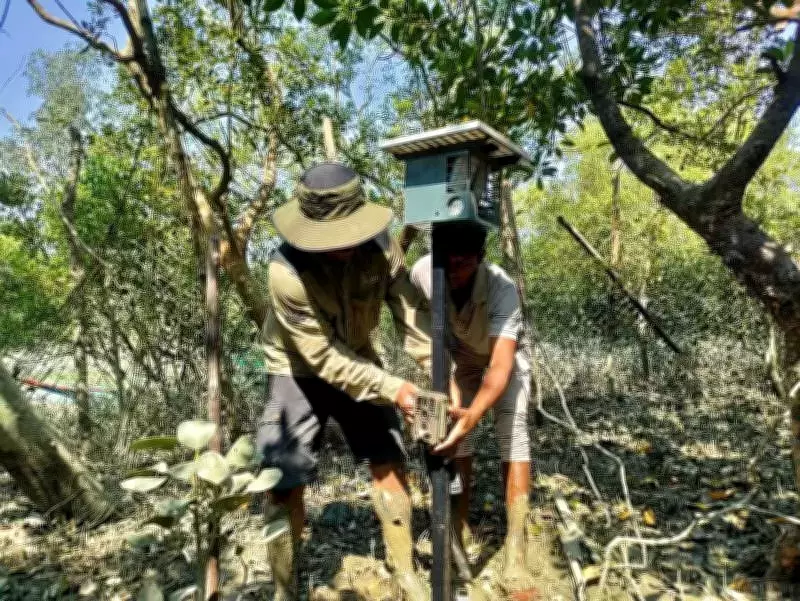
Smart Scarecrows Deployed in Sundarbans to Combat Tiger Intrusions
In a novel initiative to mitigate human-animal conflicts, the Sundarbans forest division has introduced 'smart scarecrows' to deter straying tigers from entering fringe villages. This follows previous measures such as nylon nets, solar lights, and AI cameras, aiming to create a safer buffer zone between the dense mangrove forests and human settlements.
Rising Incidents of Tiger Straying Prompt Action
Recent data highlights a growing concern, with at least 15 cases of tigers straying from the South 24 Parganas forest division into nearby villages in 2024 alone. This marks a significant increase from last year, which saw only two such incidents. A recent event in Jharkhali's Tridibnagar underscores the urgency of implementing effective deterrents to protect both wildlife and local communities.
How ANIDERS Devices Work to Repel Tigers
The smart scarecrows, officially known as ANIDERS (Animal Intrusion Detection and Repellent System), are solar-powered devices designed to scare away tigers, leopards, and other big cats without causing harm. According to Abhishek Ghoshal of the Wildlife Trust of India (WTI), which supplied four units to the forest department, these devices use sensors to trigger loud buzzes and intense light, startling animals and pushing them back into forested areas.

Key features of ANIDERS include:
- Solar-powered operation for sustainability in remote locations.
- A detection range of 25-30 meters with a 180-degree angle coverage.
- Integration with AI cameras to capture images and generate alerts.
Strategic Deployment in High-Risk Zones
The four devices were installed on Tuesday at strategic locations in the Herobhanga compartment, part of the Raidighi range in Kultali block, where human-tiger conflicts are frequently reported. These spots are chosen near canals that tigers often cross to access villages. Four additional units are slated for installation soon, enhancing the protective network.
Samrat Paul, field officer for the Sundarbans Tiger Project at WTI, emphasized that each device is positioned to maximize coverage in critical buffer zones. The initiative is part of a broader effort to monitor and adapt the technology to the unique mangrove ecosystem of the Sundarbans.
Broader Context: Tiger Populations and Carrying Capacity
The South 24 Parganas forest division, encompassing ranges like Matla, Ramganga, and Raidighi, is home to over 20 tigers, as per the latest all-India tiger estimation report. While the Indian Sundarbans hosts about 101 tigers, experts warn that numbers may be approaching the area's carrying capacity—the maximum sustainable population without triggering conflicts.
For instance, the Pilibhit Tiger Reserve in Uttar Pradesh, which also uses ANIDERS to address 'sugarcane tiger' issues, has seen its tiger population surge from 23 in 2014 to 72 in 2022, far exceeding its capacity of 30-35. This highlights a nationwide trend of increasing tiger numbers leading to more frequent human-animal encounters.
Long-Term Goals and Sustainable Solutions
Nisha Goswami, Divisional Forest Officer of South 24 Parganas, stated that the focus is shifting toward sustainable, cost-effective, and non-lethal approaches to conflict mitigation. The deployment of smart scarecrows aligns with this vision, offering a proactive solution that reduces reliance on traditional, often harmful, methods.
The WTI and forest department will closely monitor the effectiveness of these devices, with plans to refine their use based on real-time data and local feedback. As tiger conservation efforts succeed, such innovations become crucial in balancing ecological health with community safety, ensuring that both humans and wildlife can coexist peacefully in sensitive regions like the Sundarbans.