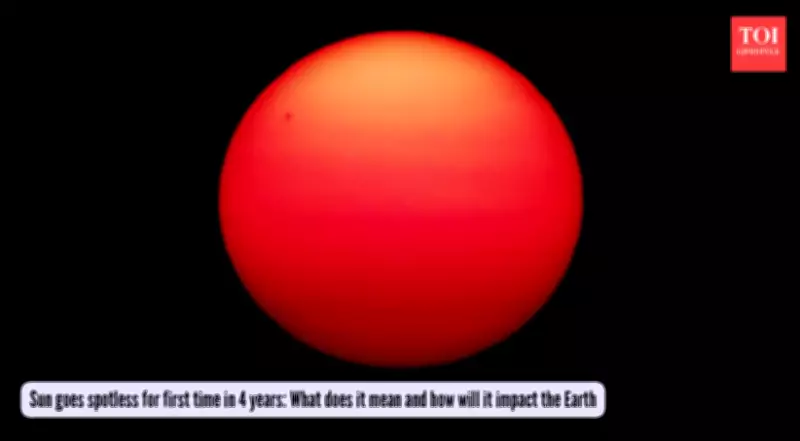
Sun Goes Spotless for First Time in 4 Years: What This Means for Earth
Our nearest star, the Sun, is far from static—it is a dynamic powerhouse that cycles through phases of intense activity and relative calm. These fluctuations influence space weather, cause technological disruptions, and even whisper subtle effects into Earth's climate systems. For centuries, humans have tracked the Sun's moods using various indicators, most notably sunspots—those dark, magnetic storms that dot its fiery surface. But are these patterns timed with precision, or are they merely random acts of nature?
Recent Observations: A Spotless Sun Emerges
Recently, the Sun was observed without any sunspots, an event that has not occurred in many years. Specifically, from February 22 to 24, 2026, the Earth-facing side of the Sun went blemish-free, marking the first spotless period in four years. Sunspots are not mere dots; they are cooler patches buzzing with intense magnetic fields. Their brief absence signals that the Sun is easing into a calmer phase of Solar Cycle 25. As reported by IFLScience, observations on February 25 already spotted a tiny sunspot peeking from the solar limb, indicating that this break in activity will not last long.
Understanding the Sun's 11-Year Solar Cycle
The Sun flips between high and low activity in a roughly 11-year cycle. Solar maximum occurs when sunspot counts peak, followed by solar minimum with sparse activity. Solar Cycle 25 crested in October 2024, after beginning from a quiet start. Dr. Rachel Howe, a solar physicist at the University of Birmingham in the UK, explained to IFLScience, "The definition of the solar maximum is when the sunspot number is at its highest. At the same time, you tend to see that that's when this polarity reversal happens. Then in the next cycle, it all happens again, but the other way around."

Around the solar maximum, solar flares and coronal mass ejections spiked until recently, often disrupting satellites and radio signals. Now, with the Sun's poles flipped and sunspots fading, the solar minimum looms around 2030.
Spotless Does Not Mean Silent: Ongoing Solar Activity
It is crucial to note that quiet phases on the Sun are not dead periods; solar flares can still erupt unexpectedly. For instance, the previous cycle's strongest flare occurred in 2017, near the 2019 solar minimum. Dr. Howe further noted, "Sometimes you can see towards the end of a cycle, regions that belong to the next cycle propping up at higher latitudes, and you can tell that they're a new cycle because they're the other way around." This highlights the continuous, albeit reduced, dynamism of our star even during calmer intervals.
In summary, the recent spotless days on the Sun mark a significant shift in Solar Cycle 25, transitioning toward a minimum. While this may reduce some disruptive space weather events, it does not eliminate them entirely, underscoring the need for ongoing monitoring and research into solar phenomena and their impacts on Earth.