

Tectonic Movements: The Ever-Changing Earth and How Continents and Ocean Basins Evolve
The Earth is a dynamic and constantly evolving planet, with its surface shaped by powerful geological forces known as tectonic movements. These processes are responsible for the formation, movement, and transformation of continents and ocean basins over geological timescales, making our world a place of perpetual change.
The Fundamentals of Plate Tectonics
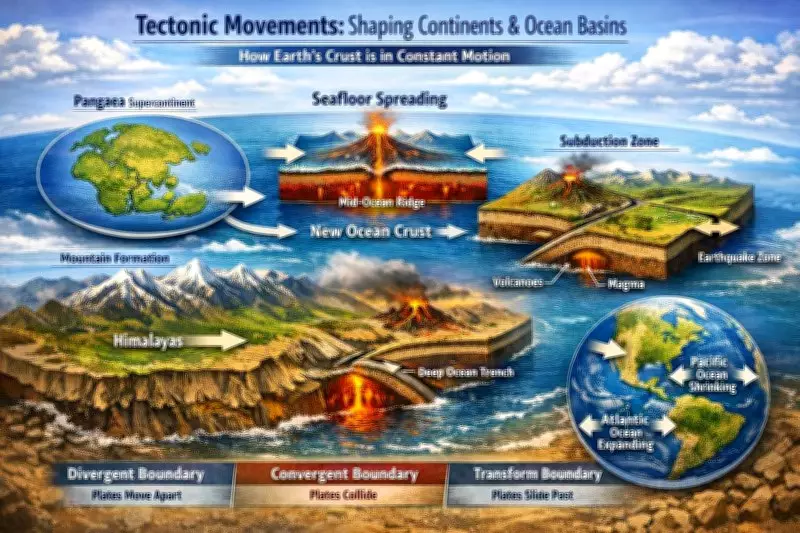
At the core of Earth's geological activity lies the theory of plate tectonics, which explains how the planet's lithosphere—the rigid outer shell—is divided into several large and small plates. These plates float on the semi-fluid asthenosphere beneath them, driven by convection currents in the mantle. The interactions at plate boundaries, where plates converge, diverge, or slide past each other, give rise to a wide array of geological phenomena, from earthquakes and volcanic eruptions to the creation of mountain ranges and deep ocean trenches.
Continental Drift and the Evolution of Landmasses
Continents are not static entities; they have been in motion for hundreds of millions of years, a concept first proposed by Alfred Wegener in the early 20th century as continental drift. Today, this idea is integrated into plate tectonics, explaining how continents like Pangaea broke apart and drifted to their current positions. The process involves:

- Rifting: Where tectonic forces pull continents apart, creating rift valleys that can eventually form new ocean basins.
- Collision: When continents converge, they can crumple and uplift to form massive mountain belts, such as the Himalayas.
- Subduction: Where oceanic plates sink beneath continental plates, leading to volcanic activity and the recycling of crustal material.
These movements not only alter the geography of continents but also influence climate patterns, biodiversity, and the distribution of natural resources over time.
Ocean Basin Dynamics and Their Role in Earth's System
Ocean basins are equally dynamic, evolving through processes like seafloor spreading and subduction. At mid-ocean ridges, tectonic plates diverge, allowing magma to rise and create new oceanic crust. This continuous addition of material pushes older crust away, a mechanism that drives the expansion of ocean basins. Conversely, at subduction zones, oceanic plates are consumed back into the mantle, leading to the closure of basins and the potential formation of new continents through accretion.
The evolution of ocean basins is crucial for regulating Earth's climate and geochemical cycles. For instance, the opening and closing of seaways can alter ocean currents, affecting global temperature and weather patterns. Additionally, the recycling of crust at subduction zones plays a key role in the carbon cycle, impacting long-term climate stability.
Implications for Geology and Human Understanding
Studying tectonic movements provides invaluable insights into Earth's history and future. By analyzing rock formations, fossil records, and seismic data, geologists can reconstruct past continental configurations and predict potential geological hazards. This knowledge is essential for:
- Resource Exploration: Identifying mineral and hydrocarbon deposits linked to tectonic settings.
- Disaster Preparedness: Mitigating risks from earthquakes and volcanic eruptions in tectonically active regions.
- Environmental Management: Understanding how tectonic processes influence ecosystems and climate change.
In essence, the ever-changing nature of Earth's surface, driven by tectonic movements, underscores the interconnectedness of geological, biological, and atmospheric systems. As research advances, our comprehension of these processes continues to deepen, revealing the intricate tapestry of our planet's evolution.






